


Last summer’s Olympic Games are a fading memory as traffic hums down the Avenida das Americas.
Cars speed by the scene of a crash a year ago that took the life of a foreign sportsman – and saved the life of a local woman.
Here, a few kilometres from Olympic Park in Rio de Janeiro, the coach of Germany’s canoe slalom team, Stefan Henze, was returning to the Olympic village in the early hours of August 12 when the taxi he was riding in careered off the road and struck a concrete barrier.
Christian Kaeding, a sports scientist with the team and also a passenger, suffered minor injuries; Henze, 35, sustained severe head trauma, underwent emergency brain surgery at the city’s Miguel Couto Hospital and died three days later.
The police report said the taxi driver had “failed to obey traffic regulations.” There was no further word on the cause of the accident. No alcohol was found in the driver’s blood.
Henze won a silver medal in the men’s C-2 (canoe double) slalom at the 2004 Olympic Games in Athens. Courses for the event are up to 600 metres long, with whitewater and rocks. Between 18 and 25 gates must be negotiated, six to seven of which are upstream.
For that you need a strong heart.
“The 15th of August is like my new birthday,” says Ivonette Balthazar, 67, at her flat in the Rio neighbourhood of Copacabana.
On a chest of drawers in the entrance area stands a model of the iconic Christ the Redeemer statue overlooking the city. Next to it is a somewhat yellowed metal plate inscribed with the word “LOVE,” the red “O” in the shape of a heart.
The heart in Balthazar’s breast now beats strongly. It used to be Henze’s.
He was carrying an organ donor card. Besides his heart, Henze’s liver and kidneys were also donated, with his family’s consent, saving the lives of another three people.
At 5:30pm on that fateful day in August, Balthazar’s telephone rang.
Just 15 minutes later, she was in Rio’s National Institute of Cardiology, where Henze’s heart was transplanted into her chest. At the time, she had no idea who the donor was.
But her journey was far from over just because she got a new heart.
Some five months after the transplant, before Christmas, Balthazar was weak and had to wear a mask over her nose and mouth on account of her suppressed immune system – she was taking up to 40 pills a day to prevent her body from rejecting the new organ.
In January, she had to spent 15 days in hospital.
And there are still many foods she’s not allowed to eat. “I dream of shrimp,” she says. She’s often feverish and weak – “mainly because of the medications.” But she recently walked two kilometres on a treadmill, and on good days she can stroll along the Copacabana Beach promenade with her daughter, Renata, and her grandchildren.
“I’ve spent so much time at home and in the hospital that I need a lot of protection from the sun though,” she remarks.
A year later, Balthazar is slowly getting better. She says she often thinks of Henze’s family, of how her new lease of life was borne of their tragedy.
She keeps breaking into tears. “I’d love so much to hug them.”
Until August 15, 2016, Balthazar was dying. Her condition was worsening rapidly after a severe heart attack, and her heart function was only 30 per cent.
“I was ready to die,” she says. “Then I got a golden heart.”
Henze’s family didn’t want the organ donations to be made public, but Brazilian media reported the story while the Olympics were still under way.
Michael Trummer, the German Canoe Association’s head coach for slalom, said everyone wanted Henze’s relatives to have “peace and quiet so they can return to their normal lives insofar as that’s possible.”
The team – athletes and coaches – will “honour the memory of Stefan as a great athlete, coach and human being,” he said.
Balthazar hopes the tragedy will boost organ donations in her country. She’s now invited to give talks to appeal for more of them.
According to official statistics, there were 357 heart transplants in Brazil (population 207 million) in 2016. In Germany (population 82 million) last year, 1,448 organs were transplanted, including 139 hearts, says the German Organ Transplantation Foundation.
“It’s an unbelievable gift of life,” says Renata.
Balthazar’s dream – besides shrimp – is to make a pilgrimage next year to the Fatima shrine complex in Portugal, where three children reported seeing the Virgin Mary while tending sheep 100 years ago.
She says she’d also like to travel to Germany sometime to personally thank Henze’s family. -DPA
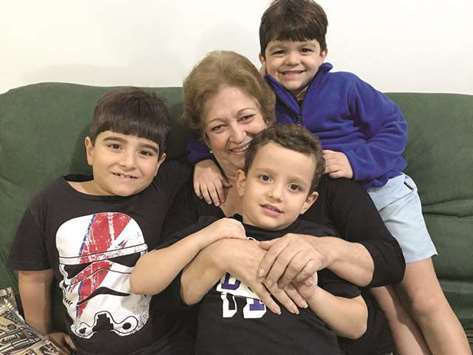
Ivonette Balthazar poses with three of her five grandchildren. The 67-year-old Brazilian woman is slowly getting better after receiving a donated heart from the coach of Germany’s canoe slalom team after he died in a car accident during the Olympic Games in Rio de Janeiro in 2016.