


More than 1,000 criminal complaints for high treason have been filed against German Chancellor Angela Merkel since the height of the refugee crisis in 2015, local media reported yesterday.
Most of the complaints come from supporters of the right-wing populist Alternative for Germany party, which is poised to win seats in the federal parliament for the first time in next month’s general election, the daily Mannheimer Morgen newspaper said.
“The complaints against the chancellor have all been determined to be baseless,” a spokeswoman for the federal prosecutor’s office, Frauke Koehler, told the paper.
Federal prosecutors in the southwestern city of Karlsruhe are responsible for investigating state security offences and are required by law to review all criminal complaints of this nature.
Merkel’s decision to let in more than 1mn asylum seekers in 2015 and 2016 sent support for her conservative Christian Democratic Union party into a nosedive but her support has recovered as new arrivals have dwindled.
She now enjoys a double-digit lead in the polls against her Social Democratic rival Martin Schulz in her bid for a fourth term.
However, AfD supporters have been turning out in force to protest at many of her campaign rallies, particularly in the former communist east of the country.
In Bitterfeld-Wolfen late Tuesday, Merkel was met with a chorus of boos and cries of “get out!”.In a state election last year, the AfD scored around 32% of the vote in the city, once the heart of East Germany’s chemicals industry.
At a later campaign event in the eastern city of Brandenburg an der Havel, the chancellor was also jeered, with some demonstrators holding signs saying “Merkel must go!”, echoing a pro-democracy rallying cry in the late 1980s, “The (Berlin) Wall must go!”.
The AfD, which groups extremist anti-Muslim and anti-migrant forces with more moderate voices, is currently polling at between eight and nine per cent
Merkel hopes to secure a fourth term as German chancellor in September’s election.
Her campaign proclaims that life in Europe’s biggest economy is just fine. But, at least in one part of Germany, the mood is decidedly downbeat and disillusioned.
“There is no future here. Nothing at all,” said Tommy, a 23-year-old student from the east German town of Bitterfeld-Wolfen, the site of one of the scores of campaign stops Merkel is making in the run-up to the September 24 election.
Indeed, 28 years after the breaching of the Berlin Wall, Bitterfeld-Wolfen is still struggling to find its feet, with a shrinking population and high unemployment. The far-right Alternative for Germany (AfD) has established a stronghold here.
Like many in Bitterfeld-Wolfen, Tommy talks about heading off as soon as possible to where he said the jobs are — namely west Germany.
“Many have moved to Baden-Wuerttemberg,” said Nancy, a 36-year-old shop assistan, referring to the south-western state which is home to large slabs of the nation’s powerhouse economy, such as Porsche, Mercedes-Benz, SAP and Hugo Boss.
Merkel has focused her election campaign on stability — offering voters a safe pair of hands on a troubled global stage, paired with job security, pensions and health care at home. She regularly points to how unemployment has halved during her 12 years in power.
The result has been that Merkel’s conservative Christian Democrats CDU and their Bavarian-based Christian Social Union (CSU) allies have built up a commanding lead over their main rivals ahead of the election.
Helping Merkel to present herself as an efficient manager has been the nation’s solid economic performance. “For a Germany in which we live well and happily,” is the CDU’s campaign slogan.
Granted, unemployment in Bitterfeld-Wolfen might have recently edged down, but, at 7.9%, remains above the national average of 5.6%.
“It will take a long time before things are better here,” said Tommy, who is a part of Generation Merkel — those that came of a political age under the chancellor. Tommy has no plans to vote next month.
A former hub of communist East Germany’s chemical industry, Bitterfeld-Wolfen was once considered an environmental disaster zone.
But a massive clean-up following the fall of the Berlin Wall has turned the region into a showcase for redeveloping troubled industrial areas.
Today, however, Bitterfeld-Wolfen still feels like a broken town, with undertones of anti-foreigner feelings.
The hostility to migrants that characterise parts of eastern Germany has helped the AfD to mobilise opponents of Merkel’s liberal refugee stance.
“The political leaders have failed,” said 33-year-old Nicole, a mother of four, who declared she had no interest in politics or any plans to vote.
“Most people want to move to the big cities,” she said, sitting with a friend in Bitterfeld-Wolfen’s main central square.
Many of the younger people attending the Merkel rally seemed to identify with the almost 50% of the population that have told pollsters they have still not made up their minds.
“We need a fresh wind,” said Kevin, a 19-year-old first-time voter said looking back over the Merkel years.
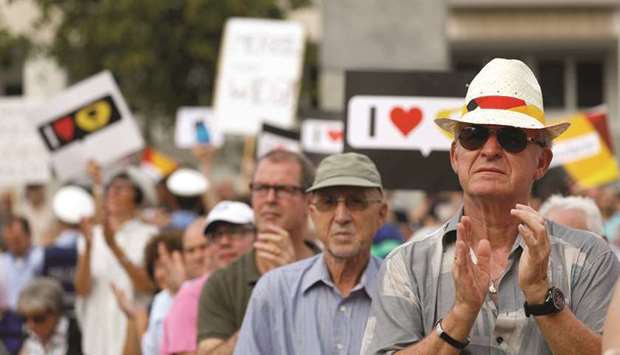
A supporter of Chancellor Angela Merkel attends an election rally in Ludwigshafen.