


How much do you know about ferro-silicon? Unless you’re a specialist in the field of ferro-alloys, the answer to that question is probably “not very much”. Although it’s an essential input into many different types of steel product, ferro-silicon is one of those industrial materials that barely registers with the general public.
Search for it on Google and you’ll get less than 400,000 “results”. Do the same for aluminium and you’ll get over 400mn.
Try the search in Chinese, though, and you may get a different outcome because this esoteric part of the global manufacturing chain has experienced a mini mania over the last few weeks.
Not that the thousands of Chinese punters who have bought into the Zhengzhou ferro-silicon market are experts in the world of ferro-alloys either.
Rather, it is just the latest Chinese commodities market to experience the turbulent effects of an investment crowd surge. Such stampedes are becoming more frequent and are hitting ever more parts of the commodity trading spectrum with increasingly chaotic effects on pricing.
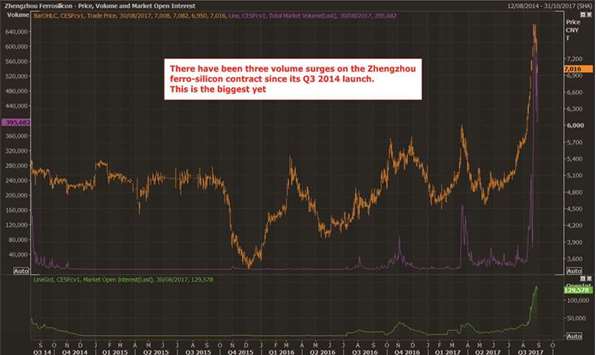
After an initial flurry of activity, both volumes and open interest flatlined over the course of 2015 and most of 2016.
Volumes totalled 1.32mn lots last year with open interest just 2,700 lots at the end of December.
Fast forward eight months and ferro-silicon trading has gone super nova.
Volumes over the last five trading days have totalled an astonishing 2.82mn contracts, while open interest has exploded to 138,396 contracts from just 30,100 at the start of August.
What has an obscure market like ferro-silicon done to warrant such attention?
Analysts at Jefferies Equity Research, one of the very few mainstream houses to cover the market, argue that both silicon metal and its alloy derivatives are benefiting from a combination of rising input prices, improving demand and constrained supply. But that doesn’t explain the ferocity of this month’s price rise nor what is shaping up to be an equally violent counter-reaction.
Rather, ferro-silicon appears to have been flavour of the month simply because it is used in steel and trading in China’s steel and iron ore contracts was getting too hot for many punters. You can track the movements of China’s commodities crowd by the measures taken against it by the authorities.
The first clamp down against speculative excess came on August 11, when the Shanghai Futures Exchange (ShFE) announced fee hikes and position limits on its steel rebar contract.
One week later, on August 18 the Dalian Commodities Exchange did the same with other components of the ferrous trading suite such as coke, coking coal and iron ore. Note that the weapons of choice for exchanges in damping excess are margin hikes and intraday trading fees, attesting to both the high leverage and high speed of China’s crowd traders.
This week it was ferro-silicon. Next week it could be something else.
Maybe silico-manganese, the sister contract on the Zhengzhou exchange. It has seen some spill-over activity but nothing quite as dramatic as the ferro-silicon contract. But it could, equally, be aluminium or copper or lead.
No-one, least of all the crowd itself, seems to know. There are only a few broad rules of this Chinese trading game.
First, it helps to have a strong story line to catch everyone’s attention.
The bull narrative in China’s steel sector is one of booming production and profits thanks to the government’s ongoing elimination of outdated capacity.
Second, it helps if the crowd has some previous experience of trading the contract. This, for example, is the third time the Zhengzhou ferro-silicon contract has seen volume and open interest surges.
The latest is, by some margin, the greatest.
* Andy Home is a columnist for Reuters. The views expressed are those of the author.
.