


US President Donald Trump arrived yesterday in Texas to survey the damage of Tropical Storm Harvey, the biggest natural disaster of his tenure, as record-setting rainfall lashed Houston and tens of thousands of people fled flooded homes.
The slow-moving storm has brought catastrophic flooding to Texas, killing at least 11 people and paralysing Houston, the fourth most-populous US city.
City officials were preparing to shelter up to 19,000 people, with thousands more expected to flee the area as the flooding entered its fourth day.
A wide swath of Houston and its surrounding suburbs were under water and forecasters warned the rain would continue through tomorrow, stressing the dams and drainage systems that protect the low-lying US energy hub.
Officials in Harris County, where Houston is located, warned area residents to evacuate as they released water from overflowing reservoirs to alleviate pressure on two dams, a move that would add to flooding along the Buffalo Bayou waterway that runs through the area.
Trump, speaking in Corpus Christi near where Harvey first came ashore last week as the most powerful hurricane to strike Texas in more than 50 years, said he wanted the relief effort to stand as an example of how to respond to a storm.
“We want to do it better than ever before,” he said.
Trump later spoke to a crowd of people affected by the storm.
“This storm, it’s epic what happened. But you know what, it happened in Texas and Texas can handle anything,” Trump said, before waving a Texas state flag over the crowd, standing on a stepladder near a fire truck.
Harvey has drawn comparisons with Hurricane Katrina, which devastated New Orleans 12 years ago, killing 1,800 people.
Former president George W Bush was widely criticised for his administration’s handling of the response to that disaster, taking a heavy toll on public support of his administration.
An 11th death was reported yesterday. A Houston officer drowned in his patrol car, the Houston Chronicle reported, citing three Houston Police Department officials.
Some 3,500 people have been rescued from high waters in the Houston area with police, firefighters and National Guard troops continuing to try to locate those marooned in high waters.
Large numbers of civilians also formed ad hoc rescue groups, many using boats to pluck neighbours from flooded homes.
The storm broke rainfall records for the continental United States, with one site south of Houston recording 49.2 inches (1.25m) of precipitation since the storm’s start.
The rainfall about what the region typically sees in a year and exceeds 48 inches (1.22m) recorded in 1978.
Multiple looters were arrested overnight, police said. About 9,000 evacuees were staying at Houston’s George R Brown Convention Center and Houston Mayor Sylvester Turner said his office had asked the Federal Emergency Management Agency for assets to allow the city to shelter another 10,000 people.
“I’m just trying to stay strong,” said Julio Gamez, 35, who evacuated to the centre on Saturday night with his wife after floodwaters rose to within a foot (30cm) of his roof.
“We’ve lost everything. But at least we’re safe.”
Other shelters were set up in Dallas, about 400km to the north, for about 8,000 people, and Austin, 260km west, to take in 7,000 people.
The Red Cross said it had 34,000 cots in the region and enough food for that many people.
Harvey was also drenching Louisiana 12 years after Hurricane Katrina hit the state and killed 1,800 people. The slow-moving storm’s centre was in the Gulf of Mexico about 150km southeast of Houston by midday Monday.
It was likely to remain just off the coast of Texas through yesterday night before moving inland early today, according to the US National Hurricane Center.
Harvey was expected to produce another 15cm to 30cm of rain through tomorrow over parts of the upper Texas coast into southwestern Louisiana.
The Gulf of Mexico is home to half of US refining capacity.
The reduction in supply led gasoline futures to hit their highest level in two years this week as Harvey knocked out about 16% of total US refining capacity, based on company reports and Reuters estimates.
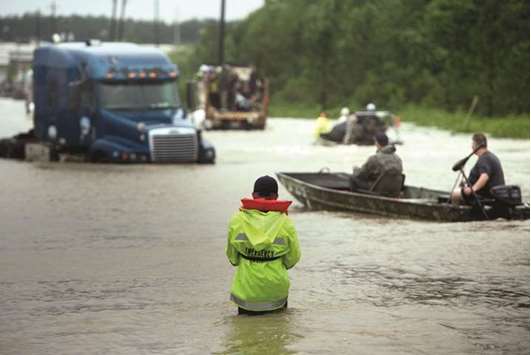
People make their way through a flooded street during the aftermath of Hurricane Harvey in Houston yesterday.