


Khaled Khudr starts with the basics in the room full of Germans and other foreigners: “Why do you want to learn Arabic?”
The 29-year-old Syrian is on a mission to introduce his culture and the Arabic language to his new European “homeland.”
Thorough workshops, he attempts to provide a glimpse “from Khudr’s eyes” into life in Syria before and after the uprising that started in 2011 with peaceful protests and eventually descended into war.
“There are stereotypes of an uncivilised life in my country, camels, sand and very warm weather,” he tells around 40 participants before screening a video about Syria’s history, nature and culture.
Born into a Syrian middle-class family, Khudr had studied to be a biologist at Damascus University. After graduating, however, he fled from the war-torn country in 2014 due to mandatory military service.
After a dangerous journey, including days without water and sleeping in forests, he is well on his way in the integration process, finishing up German courses and waiting for university admission.
Two years ago after arriving in a wave of tens of thousands who sought shelter in Germany “seeking safety,” he is now one of many newcomers ready to share their side of the integration process.
TeachSurfing, a Berlin-based nonprofit, is ready to help.
“We found tons of events for refugees” dedicated to introducing them to the German language and culture as a part of the integration process, says Miganoush Magarian, a co-founder of Teachsurfing. But “there were not too many projects (working) the other way around.”
She launched Teachsurfing in 2015 with partner Nele Kapretz as a way to connect migrants with communities that want to learn from them.
Attendees have different reasons for wanting to learn Arabic.
“I wanted to learn Arabic for long time. I really love the language, but I didn’t have time,” says Nikke, a 24-year-old Briton.
“Since I volunteer at a couple of shelters where I deal with Syrians, I thought learning the basics of the language will be really useful.”
Magarian, an Armenian-Iranian who moved to Berlin six years ago, is convinced that refugees – many of them engineers, artists, etc – should not be viewed as a problem but as a “part of the solution.”
“When we have a workshop, we never say ‘It is for refugees.’ It is for everybody,” she says, adding that the workshops have grown more and more popular, with 35 to 60 participants at each session.
“Integration means sitting together and learning something together, so we should stop labelling them and bring everybody together.”
For some, the best place to bring people together is in the kitchen.
Basel, a 27-year-old Syrian who taught Arabic with Die Lernwerkstatt collaborative learning project for a year, recently launched a series of cultural evenings that combine language learning and cooking.
The native of Aleppo in northern Syria said he came up with the idea of a cooking event when some participants of his Arabic workshops said that “learning the language is hard and boring.”
Basel, who learned German and is working towards becoming an authorised dentist in Germany, was also concerned that integration felt like a one-direction process. “We integrate in their society. What about them integrating in our community?” he explained.
His first event didn’t attract too many people, he says, but now 15 to 20 participants from a mixture of countries show up, including Syria, France, Britain, Germany and several Arab countries.
In the co-working spot’s cozy kitchen in the Treptow neighbourhood, Basel puts some Arabic music on while another volunteer, Sameer, is making some delicious Arab dishes with the help of participants.
Anna chops tomatoes for Syrian meatballs while Corneha was hoping to learn some new vocabulary words while making a lentil soup: “Today I learned a few words, like potato.”
Basel plans to continue the donation-based workshops in the future. “This workshop comes under the umbrella of integration,” he says. – DPA
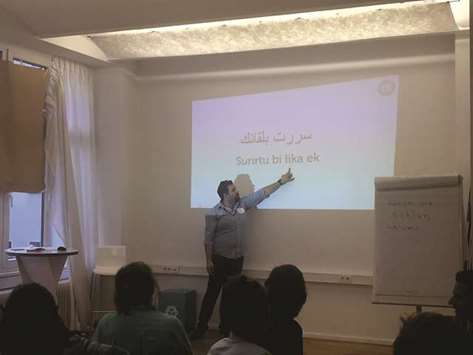
Khaled Khudr gives an Arabic lesson in Berlin. The 29-year-old Syrian is on a mission to introduce his culture and the Arabic language to his new European u201chomeland.u201d