


Floods caused by Harvey are likely to extend into Louisiana
The epic flooding that Tropical Storm Harvey unleashed on Houston will likely worsen as federal engineers release water from overflowing reservoirs to keep it from jumping dams and surging uncontrollably into the homes they protect, officials said yesterday.
Some 30,000 residents of the nation’s fourth-largest city were expected to be left temporarily homeless by Harvey, which became the most powerful hurricane to strike Texas in more than 50 years when it came ashore on Friday near Corpus Christi, about 354km south of Houston. Death estimates vary, but at least two people have been confirmed killed by the storm.
It was expected to remain over the state’s Gulf Coast for the next few days, dropping a year’s worth of rain in about a week, with threats of flooding extending into neighbouring Louisiana.
In scenes evoking the aftermath of Hurricane Katrina in New Orleans in 2005, police and Coast Guard teams have rescued some 2,000 people so far, plucking many from rooftops by helicopter, as they urged the hundreds believed to be marooned in flooded houses to hang towels or sheets outside to alert rescuers.
Texas Governor Greg Abbott activated all 12,000 members of the state’s National Guard, who joined local police in the effort to rescue people before waters rise again, with another 15 inches to 25 inches of rain expected in the coming days.
“The goal is rescue. That’s the major focus for today,” Houston Mayor Sylvester Turner told reporters.
Harvey’s centre was 148km southwest of Houston yesterday morning and forecast to arc slowly toward the city through tomorrow, with the worst floods expected later that day and on Thursday.
Schools, airports and office buildings were closed throughout in the metropolitan area, home to 6.8mn people, on Monday as chest-high water filled some neighbourhoods in the low-lying city.
Numerous refiners shut operations, likely for weeks, in the nation’s refining and petrochemical hub.
The US Army Corps of Engineers said yesterday that it was releasing water from the nearby Addicks and Barker reservoirs into Buffalo Bayou, the primary body of water running through Houston.
Officials warned that would lead to more flooding.
“The water in the Buffalo Bayou is not going to be going down soon...the more they release it could go up and it could create even additional problems,” Turner warned.
The release was necessary to prevent an uncontrolled surge of water, which Turner said “would be exponentially worse”.
Torrential rain also hit areas more than 240km away, swelling rivers upstream and causing a surge that was heading toward the Houston area, where numerous rivers and streams already have been breached.
Some areas have already seen close to 1.02m of rain, according to the National Weather Service.
By the end of the week in some Texas coastal areas the total precipitation could reach 127cm, which is the average rainfall for an entire year, forecasters said.
About 5,500 people were in shelters as of yesterday morning, city officials said, with FEMA Administrator Brock Long forecasting that as more than 30,000 people would eventually are expected to be placed temporarily in shelters.
Many area residents were left in limbo, wondering what remained of their flooded homes. Their number included Kristina Pederson, 25, who was stocking up on food for the 10 dogs that were staying with her, her grandmother and sister after the family abandoned its farm and 20 head of cattle outside the city.
“We left them there and hoped for the best. They have 500 acres and some high ground so we’re hoping they are OK,” said Pederson, who added that she had no regrets for fleeing her property.”Lives are more important than houses. Houses can be rebuilt.”
Authorities ordered more than 50,000 people to leave parts of Fort Bend County, southwest of Houston, as the Brazos River was set to crest at a record high of 59 feet this week, 14 feet above its flood stage.
Houston did not order an evacuation due to concerns about people being stranded on city highways now consumed by floods, Turner said.
FEMA’s Long yesterday did not question the decision, saying the “evacuation of the city of Houston could take days, days, literally days”.
Abbott, who had suggested on Friday that people leave the area, on Monday told CBS This Morning that “the time for making that determination has passed, and (there’s) no need to for us to relitigate that issue right now.”
US President Donald Trump plans to go to Texas today to survey the damage, a White House spokeswoman said on Sunday. Yesterday he approved an emergency declaration for Louisiana.
Trump, facing the first big US natural disaster since he took office in January, signed a disaster proclamation for Texas on Friday, triggering federal relief efforts.
Almost half of the US refining capacity is in the Gulf region. Shutdowns extended across the coast, including Exxon Mobil’s facility in Baytown, the nation’s second largest refinery.
About 13% of daily US production capacity was offline as of yesterday morning. The outages will limit the availability of US gasoline and other refined products and push prices higher, analysts said.
Gasoline futures rose as much as 7% yesterday.
Damages are not likely to be as extensive as Katrina, which killed 1,800 people in and around New Orleans, or Sandy, which hit New York in 2012, said a spokeswoman for Hannover Re, one of the world’s largest reinsurers. Those caused $80bn and $36bn in insured losses, respectively.
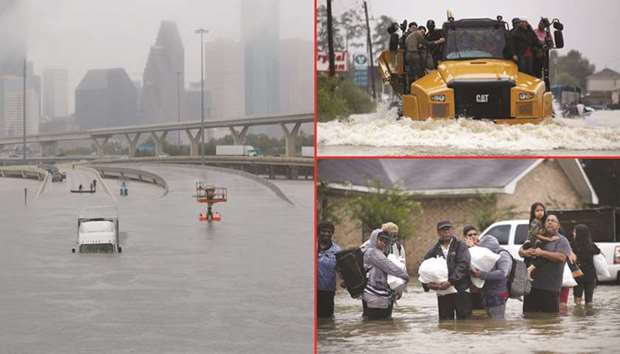
Interstate highway 45 in Houston, Texas. TOP RIGHT: People catch a ride on a construction vehicle down a flooded street as they evacuate their homes. BELOW RIGHT: People evacuate their homes in Houston, Texas.