


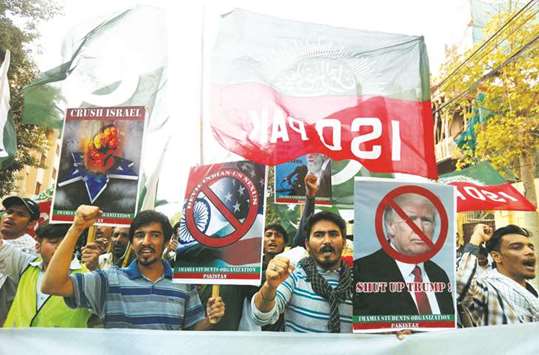
The delegation led by Assistant Secretary of State for South Asia Alice Wells was set to be the first major visit by an American official since the president’s comments.
“At the request of the Govt of Pakistan, the visit of the US delegation has been postponed until a mutually convenient time,” the foreign ministry said late Sunday.
In a major speech outlining US policy on Afghanistan Trump slammed Pakistan for offering safe havens to “agents of chaos” and suggested relations would be adjusted immediately.
He offered few details.
Successive US administrations have criticised Pakistan for maintaining links with the Taliban and harbouring leading jihadists — like Osama bin Laden.
Following Trump’s remarks, Secretary of State Rex Tillerson also cautioned that Pakistan could lose its status as a major US ally and see its US military aid suspended.
Pakistan’s powerful military chief General Qamar Javed Bajwa, in comments after the speech, demanded “trust” rather than continued financial aid from Washington.
Islamabad has repeatedly denied claims of being soft on militancy, accusing its ally of ignoring the thousands who have been killed in Pakistan and the billions spent fighting extremists.
Meanwhile, days after the White House accused Pakistan of continuing to harbour terrorists on its soil, the top US commander in Afghanistan claimed that the United States “knows the Afghan Taliban leadership is in Pakistani cities of Quetta and Peshawar”.
The allegation elicited a sharp reaction from Islamabad, which has been fuming over the US president’s harsh remarks, with top government ministers calling upon the US to stop blaming Pakistan for its failure in Afghanistan.
General John W Nicholson, who has been commanding the US forces in Afghanistan since March last year, told Afghan media outlet Tolo News on Saturday that Washington was aware of the Afghan Taliban leadership’s presence in Peshawar and Quetta, adding that the US military would continue to put pressure on Taliban sanctuaries inside and outside Afghanistan.
“The Quetta shura, Peshawar shura – these shuras are identified by cities inside Pakistan; we know Afghan Taliban leaders are in these areas. Support for terrorists and insurgents has to be reduced – [it] has to be stopped,” Gen Nicholson said in the interview.
According to Gen Nicholson, the matter of alleged terrorist sanctuaries was being addressed “in private” by the Pakistan and US governments. He said that Washington’s new policy for the region was not time-based, rather it relied on the fulfilment of certain conditions.
“It is our mandate to put military pressure on the Taliban,” he said, adding that Washington sought a peaceful solution in Afghanistan.
But turning the tables, Interior Minister Ahsan Iqbal said that the Taliban were using Afghanistan as the launch pad for their operations, both inside and outside Pakistan.
He said the Taliban had no need to hide in Pakistan, since they held more than 40% of Afghanistan. “If they have control over so much land and resources in Afghanistan, it means they have hideouts there, not in Pakistan,” he said.
The minister said Pakistani authorities had been conducting comprehensive security operations in different parts of the country for four years and had cleared a large area, including North Waziristan.
Iqbal said Washington itself had stated that they would acknowledge the efforts of Pakistani forces if they managed to clear North Waziristan of terrorists.
Pakistan, he said, had made the commitment that it would not allow any group to use its soil against any other country, including Afghanistan.
“Pakistan is fully committed to rooting out terrorism and no other country can match us in terms of the number of sacrifices made in the war on terror,” he added.
Separately, Foreign Minister Khawaja Asif said the US should refrain from blaming its 16 years of failures in Afghanistan on Pakistan.
“America used Pakistan as its ally, but Pakistan suffered unbearable losses in the war on terror. If the US doesn’t trust Pakistan, it should make preparations to repatriate the Afghan refugees Pakistan has been hosting for nearly 35 years,” he told Geo News yesterday.
Asif said Pakistan had been a trusted ally of the US for 70 years and had borne many direct and indirect losses due to this alliance.
“We want to clear misunderstandings with the US by maintaining this relationship.”
He stressed that peace in Afghanistan was important for Pakistan too, which was why Islamabad was helping the US in trying to find a solution to the Afghan issue.
The foreign minister, who scrapped a planned visit to Washington following US President Donald Trump’s remarks about Pakistan, said that over 90% of the attacks in Pakistan were carried out from Afghanistan and demanded US assistance in installing a border fence.
He also alleged that Afghan soldiers were selling American arms and ammunition to the Taliban.
Gen Nicholson’s statement also prompted a reaction from the provincial governments of Khyber Pakhtunkhwa and Baluchistan.