


Angola’s ruling MPLA party held a commanding lead in provisional general election results, with 64.57% of the votes tallied compared with the opposition UNITA party’s 24.4%, the electoral commission said yesterday.
Angola, home to sub-Saharan Africa’s third-largest economy, held a smooth national election on Wednesday with the MPLA’s former defence minister Joao Lourenco expected to be voted in as the Opec-member’s first new president for 38 years.
The People’s Movement for the Liberation of Angola (MPLA) earlier said it was on track to win a two-thirds parliamentary majority, based on its own numbers, as votes were still being tallied.
The provisional results were based on about 63.74% of the votes cast, said Júlia Ferreira, spokeswoman for National Electoral Commission.
Further provisional results will come out in coming days with definitive results required by law to be released within two weeks of the vote.
There were 9mn Angolans registered to vote in a country of 28mn spread across an area twice the size of France.
In Angola, political parties are allowed to observe the elections by posting party members at every polling station and by assimilating results, the parties attempt to foretell the election outcome.
The MPLA calculated earlier yesterday that after checking 5mn votes it was on course for the two-thirds majority that is required to govern alone.
“We can affirm that the future president will be comrade João Manuel Gonçalves Lourenço,”João Martins, party secretary for political and electoral affairs, told reporters.
Juilão Mateus Paulo, MPLA’s secretary general, said after the release of the provisional results: “We think we’re approaching a two-thirds parliamentary majority which would be a great satisfaction for the party.”
However, the main opposition, National Union for the Total Independence of Angola (UNITA), said the party did not recognise the provisional result, as it did not tally with its numbers.
Paulo said the opposition always complain about the vote outcome.
Before the provisional results were released, UNITA’s parliamentary head Adalberto Costa Júnior told Reuters: “Looking at the trend, the MPLA won’t have a majority at all.”
Should the MPLA win, Lourenço, a quiet 63-year-old more used to army barracks and the closed doors of party politics than the public spotlight, would replace veteran leader Jose Eduardo dos Santos.
He will remain as head of the party, however, giving him potentially sweeping powers over decision-making.
Dos Santos, 74, Africa’s longest-ruling president behind Equatorial Guinea’s Teodoro Obiang Nguema, steps down after guiding Angola from Marxism to capitalism while embracing Chinese oil-for-infrastructure investment.
His daughter Isabel heads national energy company Sonangol, which runs Africa’s second biggest oil industry.
His son, José Filomeno, is in charge of the $5 billion state investment fund.
The MPLA, which has ruled Angola since independence from Portugal in 1975, has lost some support due to political cronyism, though many Angolans remain loyal to the party that emerged victorious from 27 years of civil war in 2002.
Lourenço has promised to focus on fixing Angola’s economy which has been devastated by the fall in the price of oil.
The economy contracted 3.6% last year and is expected to post only minor growth this year.
On Tuesday, Lourenço said he did not rule out negotiating with the International Monetary Fund (IMF) or the World Bank as he sought to establish an “economic miracle” in Angola.
“We assess that the next president will seek closer cooperation with the IMF,” Robert Besseling, analysts at Exx Africa, said in a note yesterday. “It is likely that Lourenço’s presidency will be marked initially by continuity and moderate changes in policy.”
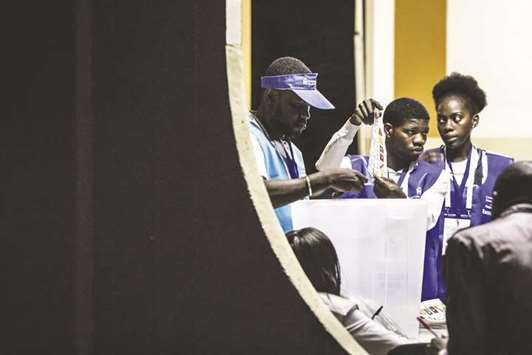
Polling station officials show ballot papers during the counting of the ballots at the end of the general election vote in Luanda.