


Emerging market equities hit three-year highs yesterday and the Mexican peso steadied after US President Donald Trump’s threats to terminate the Nafta trade treaty were dismissed.
MSCI’s benchmark emerging stocks index gained 0.5%, reversing the risk aversion that had gripped markets on Wednesday after Trump warned he might pull out of the North American Free Trade Agreement and revived threats to build a border wall with Mexico.
Both Mexico and Canada dismissed Trump’s threat to scrap Nafta as a negotiating tactic, helping the Mexican peso steady after initially falling over 1% against the dollar to one-week lows.
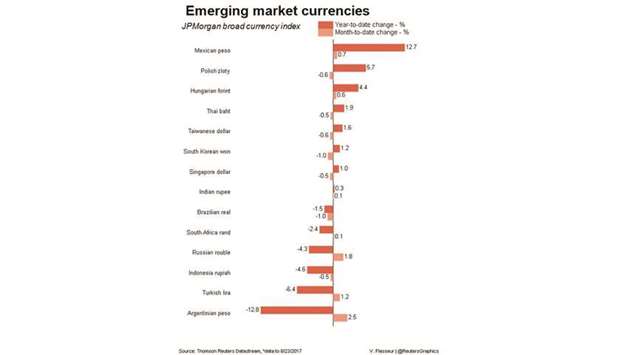
Year-to-date, the peso has performed strongly, leading emerging forex gains.
Turkey and Taiwan shares led gains in stock markets, up 0.7-0.8%, with Poland and Hong Kong up 0.4-0.5%, the latter reopening after a one-day closure for a typhoon. Per Hammarlund, chief emerging markets strategist at SEB, said the macroeconomic backdrop was still very favourable.
“You have days where you might have a bit of a pull-back but given that EM equities have lagged developed markets, they are starting to catch up now and I think that trend will hold for a while.”
Investors are awaiting speeches from Federal Reserve chair Janet Yellen and European Central Bank president Mario Draghi at the Jackson Hole central banking conference this week for clues on the withdrawal of quantitative easing.
But Hammarlund noted that both the Fed and the ECB had played down expectations. “The most likely outcome is they don’t signal too much... but given the strong economic data we have seen there is still a risk of a more hawkish signal.
That could cause some disruption for emerging markets,” he said.
Chinese mainland shares suffered their biggest fall in nearly two weeks, down 0.5%, led by a 6.7% fall in telecom company China Unicom after it rallied hard earlier in the week. Profits at China’s state-owned firms rose 23.1% in January-July from a year earlier, and China said it would defend itself and its companies against a US trade investigation.
The South African rand slipped 0.4% after consumer price inflation retreated to its lowest in nearly two years, boosting the chances of further interest rate cuts.
A fall in precious metals prices also weighed on the rand.
The Czech crown firmed 0.1% against the euro after business and consumer confidence rose, whilst the Hungarian forint was trading at fresh 27-month highs.
In bond markets, Venezuela’s benchmark 2038 sovereign dollar bond touched its lowest level since May 2016, extending Wednesday’s losses after a report that the US government was considering a ban on trading in the country’s debt.
Polls have closed in Angola’s parliamentary elections, which are expected to usher in the ruling party’s defence minister as the first new leader for 38 years.
Angolan dollar bonds were steady ahead of the results.
.