


Philippine President Rodrigo Duterte yesterday backed police on the front lines of a war on drugs that he said would not cease, but warned officers their duty was to arrest suspects and kill only if their lives were in danger.
The firebrand leader, now facing the most intense scrutiny so far in his controversial but popular crackdown, said he could not justify last week’s high-profile killing of a high school student, and police responsible had not followed instructions and would face justice.
Though Duterte stood firmly behind a campaign that has killed thousands of mostly urban poor Filipinos, his remarks were a departure from the bellicose rhetoric that critics say has created a culture of impunity and emboldened police to execute suspects.
Police reject that. “You are not allowed to kill a person that is kneeling down begging for his life. That is murder,” Duterte said in a speech.
“When I say you get him, it includes doing the arresting and then if there is a violent resistance, they (police) have to defend themselves.”
Kian Loyd Delos Santos, 17, was among more than 90 people killed in three days of intensified police operations last week that marked the bloodiest chapter of a campaign that has alarmed the international community.
Security camera footage showed a man matching the victim’s description being dragged by plain-clothes police to an alley where he was found dead.
Police said he was a drug courier, but his family insisted he was unarmed, innocent, and murdered.
His death has attracted huge domestic attention, with political opponents demanding the killings stop and some churches opposing the bloodshed and ringing bells at night in protest.
Demonstrations have taken place, the latest a small rally outside police headquarters yesterday.
Duterte has repeatedly vowed to pardon police convicted of abuses during his anti-drug campaign, but on yesterday he said there would be no protection for those who broke the rules of engagement.
“Let us be clear on this. I said I will protect those who are doing their duty. I never promised to protect those who are supposedly engaged in doing their duty but committing a crime in the process,” he said, adding that abuses “cannot be done”.
Condemnation of Duterte’s 14-month-old war on drugs has come mainly from human rights groups, political opponents and foreign critics, with Filipinos largely supportive of the campaign, echoing the government view that the suppression of drugs use is making the streets safer.
Critics say that Duterte is turning a blind eye to systematic abuses and cover-ups with an unquestioning acceptance of an official police line that typically says those killed were drug dealers who had violently resisted arrest.
“I will not change my policy, there will be war on against drugs because I have to protect the people,” he said. “I have that sworn duty to defend the people and protect the republic.”
Philippine police were knocking on doors in one of Manila’s poorest neighbourhoods yesterday to encourage people to take on-the-spot drug tests, a campaign condemned by rights groups as harassment that could endanger lives.
Carrying drug testing kits, police officers accompanied by community officials were seen by Reuters going to houses asking residents if they were willing to submit urine samples.
Payatas, one of the most populated sub-districts, or barangays, in the capital’s Quezon City neighbourhood, has been identified as a crime-prone area with a serious drug problem. Community leaders said they requested help from police, and testing was voluntary.
Dozens of Payatas residents have died during President Rodrigo Duterte’s ferocious 14-month-old war on drugs, which has killed thousands of Filipinos, many in what critics say are suspicious circumstances.
Residents say more than 300 of the 130,000 people in Payatas are already on a drug “watch list” drawn up last year by community leaders of known addicts.
Barangay watch lists are drawn up by community leaders to identify those in need of rehabilitation, but activists say some of those who appeared on them have become targets for assassination. The authorities deny the watch lists serve as hit-lists.
Yesterday Reuters saw a small number of Payatas residents lining up to be tested but the police did not say how many were found clean or to be drug users.
Community leaders did not say what will happen to people who tested positive for drug use or to those who refuse to be tested.
“Our goal is to have a drug-free barangay this year,” Payatas barangay secretary Marlene Ocampo told Reuters, adding the village council agreed to fund and conduct free and voluntary drug testing, which could take four to five months.
“We only asked the police to help us and we are grateful,” she said. “We have more than 133,000 residents.”
She said there were no complaints, and many residents agreed to undergo tests.
“This is also good for us,” said Maria Luisa Valdez, a 37-year-old food vendor. “We are clean. We don’t do drugs so why would be afraid to take the test.”
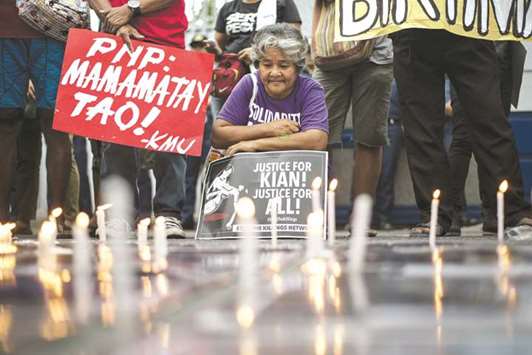
An activist holds a poster against extra-judicial killings during a protest in Manila.