


China is expanding artificial islands in disputed South China Sea areas despite saying it stopped two years ago, according to a security think tank that released satellite images it said showed the land reclamation.
Beijing claims most of the sea and has been turning reefs in the Spratly and Paracel chains into islands, installing military aircraft and missile systems on them — an activity the Asia Maritime Transparency Initiative (AMTI) said was continuing.
“China’s own reclamation work did not end in mid-2015 with the completion of its artificial islands in the Spratlys. Beijing continues to reclaim land farther north, in the Paracel Islands,” the security think tank said on its website.
Chinese Foreign Minister Wang Yi told reporters on the sidelines of the Association of Southeast Asian Nations (Asean) Regional Forum in Manila on Monday that Beijing completed its South China Sea reclamation activities two years ago.
“I also wanted to tell you that two years ago, China had already completed the reclamation.
That is something I can tell you for sure,” Wang said, adding “it is not China” which was conducting ongoing reclamation activities.
The AMTI website on Wednesday posted satellite pictures that it said showed Wang’s statements were “false”.
China has since 2015 dredged a new harbour and added 10 hectares of land on Tree island in the Paracels, and has recently completed a new helipad and installed wind turbines and photovoltaic solar arrays there, it said.
Since reclamation work to connect on two other Paracel islands was washed out by a typhoon last October, China has undertaken additional reclamation and built new structures there, it added.
China claims nearly all of the strategically vital sea, through which $5tn in annual shipping trade passes and is believed to sit atop vast oil and gas deposits.
Its sweeping claims overlap with those of Asean members Vietnam, the Philippines, Malaysia and Brunei, as well as Taiwan.
China on Sunday scored a diplomatic coup when foreign ministers from the 10-member Asean bloc released a diluted joint statement on the dispute that failed to mention China on the issue and agreed to its terms on how to negotiate a resolution.
Nevertheless, China was angered by wording in the statement pushed by Vietnam that expressed concerns by some about land reclamations, even though it did not name Beijing.
The Philippines had for many years stood alongside Vietnam as one of the strongest opponents to Chinese expansionism.
A United Nations-backed tribunal ruled last year that China’s territorial claims in the sea were without legal basis.
But the Philippines, under President Rodrigo Duterte’s new administration, decided not to use the verdict to pressure.
It instead built closer ties with China in return for billions of dollars worth of investments and aid.
Philippine Foreign Secretary Alan Peter Cayetano told reporters on Tuesday he had lobbied against referring to land reclamation in the Asean statement because he believed China had stopped.
“They (Chinese) are not reclaiming land anymore,” Cayetano said.
An angry Beijing warned off a US warship after it sailed near an artificial island in the disputed South China Sea in the latest operation aimed at loosening the Asian giant’s grip on the strategic waterway.
Foreign ministry spokesman Geng Shuang said the actions of the USS John S McCain had violated Chinese and international law, “seriously” impairing the country’s sovereignty and security.
“China is strongly dissatisfied with this,” Geng said in a statement, adding that Beijing would lodge an official protest with Washington.
The USS John S McCain destroyer sailed within six nautical miles of Mischief Reef — an artificial island built by China — on Thursday as part of a “freedom of navigation” operation, a US official said.
The reef is part of the disputed Spratly Islands in the South China Sea, which is the scene of rival claims between China and neighbouring countries.
The US official told AFP a Chinese frigate sent radio warnings at least 10 times to the USS McCain.
“They called and said ‘please turn around, you are in our waters’,” the official said. “We told them we are a US (ship) conducting routine operations in international waters.”
The official said the interactions were all “safe and professional,” with the operation lasting about six hours from start to finish, but Geng said such operations “seriously endanger lives”.
The freedom of navigation operation was the third of its kind carried out by the United States since President Donald Trump took office in January.
The US move came four days after the United States, Australia and Japan denounced Beijing’s island-building and militarisation of the South China Sea on the sidelines of a security forum of the 10-nation Association of Southeast Asian Nations (Asean) in Manila.
Chinese defence ministry spokesman Wu Qian said the situation in the South China Sea has “stabilised” due to the “joint efforts” of China and neighbouring countries but the US operation threatened “peace and stability in the region”.
“The US military’s provocative actions will only encourage the Chinese military to further strengthen the defence capacity building and firmly defend national sovereignty and security,” Qian said.
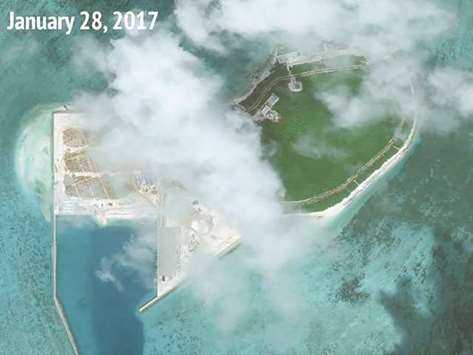
An overview satellite image of Tree Island in the disputed Paracels island chain in the South China Sea.