


Military diplomacy is a new means for Japan to confound China’s bid for control in the bitterly contested South China Sea as Prime Minister Shinzo Abe seeks a regional military role amid a retreat from decades of state pacifism.
The pact could be the first in a series of similar deals as Tokyo cranks up defence diplomacy with Southeast Asian nations eager for hand-me-down patrol aircraft, ships and other military equipment.
“This is a demonstration of the robust strategic partnership and co-operation of the two allies,” a senior Philippine Air Force commander told Reuters, adding that Japan would deliver around 40,000 parts under the deal.
The value of the parts could not be determined.
The sources, who have knowledge of talks between the two countries, asked not to be identified because they were not authorised to talk to the media.
The supply agreement will be Japan’s first military aid deal since lawmakers scrapped a rule in June barring giveaways of surplus military kit to other countries.
“We are looking at what we will do with our spare parts, but have nothing concrete we can discuss,” said a spokesman for the procurement agency of Japan’s defence ministry.
“In order to strengthen national security we want to push ahead with defence equipment co-operation.”
Malaysia, the Philippines and Vietnam have already asked about taking Japan’s submarine-hunting P3-C maritime patrol aircraft, made by Lockheed Martin Corp, as they are replaced by Kawasaki Heavy Industries P-1 planes, two of the sources said.
“There has been some preliminary discussion,” said one of the sources.
Japan worries that Beijing could blunt opposition to its territorial assertiveness in the South China Sea with arms sales and development aid to countries surrounding the busy waterway.
About $5tn of ship-borne trade passes through the sea each year, much of it touching Japanese ports.
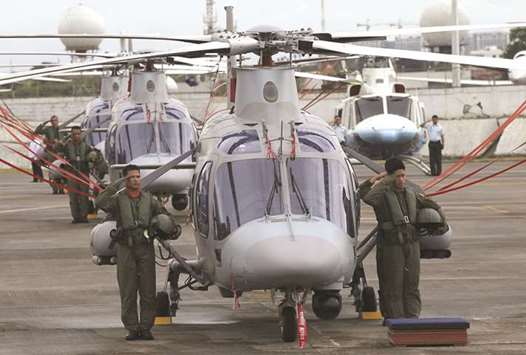
The aircraft parts for the Philippines are meant for workhorse UH-1 utility helicopters that can be used for transport or deployed as airborne gunships, the sources said.
Japan’s Ground Self-Defence Force (GSDF) retired older H versions of its Vietnam-era Hueys in 2012, after four decades of use, but retained their spare parts.
Japan earlier agreed to supply the Philippines with three second-hand Beechcraft TC-90 King Air patrol planes, in a deal structured as a lease arrangement, under the old rule.
Other initiatives by Japan to build military ties include a four-day South China Sea tour aboard its navy flagship, the Izumo helicopter carrier, by military officers of the Association of Southeast Asian Nations (Asean) in June.
Military officials of Indonesia, Malaysia, the Philippines, Singapore, Thailand and Vietnam also observed disaster relief drills in Japan.
Abe’s government believes Japan is better placed than Washington to woo Southeast Asia away from Chinese influence, as it is free from the rules forbidding the United States to fully engage with non-democratic regimes, such as Thailand and Vietnam.
Conditions set by the United States forced the Philippines to turn to China and Russia for arms supplies, the Southeast Asian nation’s defence minister has said.
China has offered to donate $14mn worth of military hardware to the Philippines, besides a soft loan for $500mn in Chinese arms.
A US Navy destroyer carried out a “freedom of navigation operation” yesterday, coming within 12 nautical miles of an artificial island built up by China in the South China Sea, US officials told Reuters.
The operation came as President Donald Trump’s administration seeks Chinese co-operation in dealing with North Korea’s missile and nuclear programmes and could complicate efforts to secure a common stance.
The officials, speaking on condition of anonymity, said the USS John S McCain travelled close to Mischief Reef in the Spratly Islands, among a string of islets, reefs and shoals. China has territorial disputes with its neighbours over the area.
It was the third “freedom of navigation operation” or “fonop” conducted during Trump’s presidency. Neither China’s defence ministry nor its foreign ministry immediately responded to a request for comment.
The operation was the latest attempt to counter what Washington sees as Beijing’s efforts to limit freedom of navigation in the strategic waters, and comes as Trump is seeking China’s co-operation to rein in North Korea. Tensions have risen recently after North Korea carried out two nuclear tests last year and two ICBM tests last month, prompting a strong round of UN sanctions which angered Pyongyang who threatened to teach the United States a “severe lesson”.