


North Korea has warned it is considering a pre-emptive strike against the US Pacific territory of Guam, hours after President Donald Trump said Pyongyang’s threats would be met “with fire and fury.”
An attack with “enveloping fire” against US military interests on the Pacific island could be conducted at any moment once approval has been given by leader Kim Jong-un, a North Korean army spokesman said yesterday, according to state media. The warning against the territory, which is home to the Andersen Air Force Base, came hours after Donald Trump said in almost unprecedented comments for a peacetime US president that if Pyongyang continued to make threats it would be met “with the fire and the fury like the world has never seen.”
North Korean leader Kim “has been very threatening beyond a normal state, and as I said they will be met with the fire and fury and frankly power, the likes of which this world has never seen before,” Trump told reporters on Tuesday at his golf resort in New Jersey. Trump remained defiant yesterday, tweeting that the US nuclear arsenal is “now far stronger and more powerful than ever before.”
“Hopefully we will never have to use this power, but there will never be a time that we are not the most powerful nation in the world!” he wrote.
Guam Governor Eddie Baza Calvo took to Facebook to reassure his citizens, saying he had spoken to the White House. “An attack or threat to Guam is a threat or attack on the United States. They have said that America will be defended,” he said.
Guam is located 2,000km east of the Philippines and has a population of around 160,000. Media reports from Tuesday said both the US and Japan had concluded that North Korea had developed a miniaturised nuclear warhead that can fit inside its missiles. In response, Japanese Defence Minister Itsunori Onodera suggested that the Japanese military might need an offensive missile capability to protect from North Korea.
The nuclear threat was particularly pointed in Japan as it was yesterday marking the 72nd anniversary of the dropping of an atomic bomb by the US on the city of Nagasaki during World War II. The Chinese government called for cool heads. “The current situation on the (Korean) peninsula is highly complicated and sensitive,”China’s Foreign Ministry said. “We hope all relevant parties speak cautiously and move prudently, stop provoking each other, avoid further escalating the situation and strive to return to the correct track of dialogue and negotiations as soon as possible.”
Catherine Ray, a spokeswoman for the European Commission, said the situation in North Korea, which is “of great concern” to the European Union, needed to be solved through “peaceful means.” “This excludes military action,” Ray said. “The situation is really serious ...Another round of sabre rattling will certainly not help us here” German Foreign Minister Sigmar Gabriel’s spokesman, Martin Schaefer, said.
“A military route cannot resolve the conflict,” Schaefer said. “We therefore call on all parties to show moderation.”
A Beijing-based expert told DPA Pyongyang’s stance was “very close to the red line” set by the US that North Korea should not threaten US security. The situation was “very dangerous,” said Zhang Liangui, a professor at the Institute for International Strategic Studies of the Central Party School of the Communist Party of China.
“In our estimation North Korea will be able to complete its intercontinental nuclear missile tests by 2018. So now the clock is ticking for the US to take any action as sanctions are apparently not working.”
Despite the escalation in rhetorical threats, North Korea expert Eric Ballbach sees no “immediate threat” of a war breaking out. Ballbach, of Berlin’s Freie Universitaet, said a military strike carried out by the US against North Korea would be problematic. “A precision strike would only make sense if we knew the exact location (of the nuclear arsenal),” he said.
A strike would also place in jeopardy “one of the most economically dynamic regions in the world,” Ballbach added, pointing at the danger such a move poses to South Korea, Japan and China. News of the increasing tensions sent the Frankfurt-based DAX and the eurozone’s EuroStoxx 50 on a downward course.
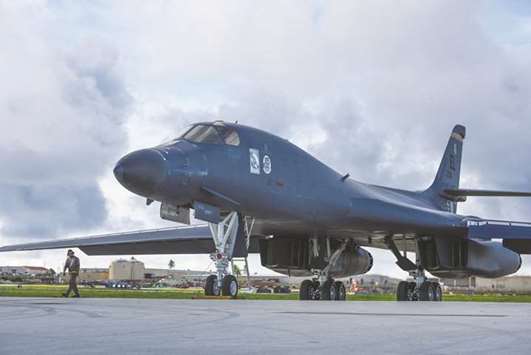
One of two US Air Force B-1B Lancer bombers prepares to take off for a 10-hour mission, to fly in the vicinity of Kyushu, Japan, the East China Sea, and the Korean peninsula, from Andersen Base, Guam.