


The ever-louder chatter about whether China is close to widening the yuan’s trading band is being met with scepticism by traders and analysts.
Of 25 people polled by Bloomberg News this month, 10 said China won’t make any moves to liberalise its exchange-rate regime this year and another eight expect different steps, such as opening the interbank market to a broader range of players. Among the seven respondents who did anticipate the yuan’s daily trading limit to be increased, several noted that the move would be a ceremonial reform, with the currency coming nowhere near its 2% cap on daily swings since the aftermath of the shock devaluation in 2015.
The yuan band has become a topic of conversation since last month, with an increasing number of comments appearing in Chinese media saying it’s time for the nation to boost exchange-rate flexibility. As the currency heads toward its first annual advance against the dollar since 2013, officials can no longer blame a rocky external environment for maintaining their grip.
Still, for analysts at Mizuho Bank and JPMorgan & Chase Co, that might not be enough of a reason to act.
“Suspected central bank intervention has kept daily moves far from the 2% limit, so it would be meaningless to widen the band without reducing intervention,” said Ken Cheung, Mizuho’s senior currency strategist in Hong Kong. The most likely next step for reform would be allowing higher volatility of the spot trading with less intervention, he said.
Here are some of the other findings in the August 1-August 7 survey: The yuan will drop 1.6% the rest of this year to 6.8 per dollar, according to the median estimate, and finish June 2018 at 6.85. The Chinese currency traded in Shanghai advanced for a third day in Shanghai yesterday, rising as much as 0.45% to 6.6775, the strongest level since September 30.
The onshore yuan completed its third monthly advance in a row in July – the longest run of gains since October 2014 – amid a decline in the Bloomberg Dollar Spot Index, signs of an improving economy and the suspected intervention. The People’s Bank of China was speculated to have stepped into the market to prop up its exchange rate at least three times in June.
The improving sentiment comes before a key Communist Party meeting to be held this fall, with the Politburo on July 24 calling for policy consistency to create a “favourable environment” ahead of the gathering. Stability and the control of risk was also the theme at a twice-a-decade National Financial Work Conference last month.
“The conference listed improving the currency market’s mechanism as part of financial reforms,” said Cheng Shi, chief economist at ICBC International Holdings Ltd in Hong Kong. “Given the strategic requirement for financial stability, extending trading hours to attract more market participants is more likely than widening the trading band or boosting daily volatility.”
To Scotiabank currency strategist Gao Qi, now is a favourable time to expand the daily range.
“When there are strong one-way expectations, it’ll be too late to widen the trading band,” said Singapore-based Gao, who predicts the change may happen before US President Donald Trump’s planned visit to China later this year.
The participants in the Bloomberg survey included JPMorgan Chase & Co, Commerzbank, Scotiabank, Royal Bank of Canada, Mizuho Bank, Bank of Tokyo-Mitsubishi UFJ, United Overseas Bank, Commonwealth Bank of Australia, ING Group NV, Banco Bilbao Vizcaya Argentaria SA, National Australia Bank, BOC International Holdings, CCB International Securities, ICBC International Holdings, Shanghai Commercial Bank, China Securities International Finance Holding Co, Bank of Communications Co, Ping An Securities Co, China Merchants Securities Co, Chinese Academy of Social Sciences, and CEBM Group. Four traders and analysts asked not to be identified as they are not allowed to comment publicly on such matters.
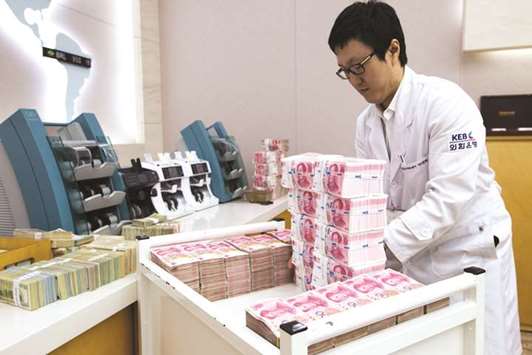
An employee arranges yuan banknotes at the Korea Exchange Bank headquarters in Seoul. The ever-louder chatter about whether China is close to widening the yuan’s trading band is being met with scepticism by traders and analysts.