


Belgian investigators have reported that they have found eggs with dangerous levels of the insecticide fipronil, the country’s national food safety authority FASNK said.
And in a new twist in Europe’s tainted egg scandal, Dutch authorities announced yesterday that they had started testing chicken meat coming from affected poultry farms to determine whether it was also contaminated.
Scientists are looking for the presence of the insecticide fipronil, a substance potentially dangerous to humans, after supermarkets in Germany, the Netherlands, Belgium, Sweden and Switzerland pulled millions of eggs from the shelves.
“We are testing chicken meat in the poultry farms where eggs were infected to determine whether the meat is contaminated as well,” Tjitte Mastenbroek, spokesman for food security agency NVWA, said.
The probe focuses on “a few dozen” farms that produce both eggs and chicken meat, NVWA said.
Meanwhile, the Dutch Safety Board, the country’s agency looking into civilian safety issues, announced that it was opening its own probe into why fipronil was not detected earlier in eggs as well as “the role in this of the poultry sector and Dutch government”.
“The way consumers have been informed about the risks of fipronil are also being investigated,” the Hague-based OVV said in a statement.
Millions of chickens now face being culled in the Netherlands as the scandal widens across Europe.
A probe by authorities in the Swedish city of Gothenburg showed that one wholesale dealer in Gothenburg had imported tainted eggs from the Netherlands, and distributed about 11,000 eggs in the past two weeks.
The wholesaler has “co-operated fully, and stopped sales” and also helped the city’s environment department to contact restaurants and
get them to destroy eggs that have not been used, said department head Bernadett Weber.
The Swedish National Food Agency said it considered possible health risks were small for Swedish consumers, partly as 95% of eggs consumed in Sweden are from domestic farmers.
Meanwhile hard-hit Germany has called on Belgian and Dutch authorities to quickly shed light on what it termed a “criminal network” involved in the contamination of eggs with fipronil.
“When one sees a criminal energy that’s almost organised as a network it’s unacceptable,” said German Agriculture Minister Christian Schmidt.
He again criticised Belgian and Dutch authorities’ tardy response to the crisis.
“It’s not in the spirit of the early warning system to be aware in June but only to inform us by the end of July,” Germany’s Schmidt said.
On Monday Belgium’s top agricultural official ordered the country’s food safety agency to report within a day why it failed to notify neighbouring countries until July 20 despite knowing about fipronil contamination since June.
Yesterday Belgian investigators reported that they have found eggs with dangerous levels of fipronil, the country’s national food safety authority FASNK said.
The analysis in Belgium, the first country to report a possible mass contamination, found 0.92mg per kg (mg/kg) of the substance, which exceeds the EU-mandated health safety level of 0.72mg/kg.
On Monday, FASNK said that the highest level of fipronil measured in Belgium had been 0.096 mg/kg.
The food safety body was deciding on what measures to take in light of the new figures.
Mastenbroek told AFP that a criminal probe by the NVWA under Dutch prosecution authorities and assisted by Belgium is continuing, looking at the role of companies in contaminating Dutch poultry farms with fipronil.
Meanwhile, the French government said on Monday that “thirteen batches of contaminated eggs from the Netherlands” were delivered in July to food processing companies located in central-western France.
Mastenbroek said so far her agency’s “highest priority” has been the detection of contaminated eggs.
“But now we also have the time to look at meat as a precautionary measure,” she said.
Most farms exclusively produce one or the other, said Eric Hubers at LTO, a Dutch farming organisation.
If the meat tests are negative for fipronil, producers will be cleared to resume sales, Mastenbroek said.
LTO said the probability of chicken meat found to be infected was small.
However, if fipronil was detected “farming will be completely suspended”, Dutch agency NVWA’s Mastenbroek said.
The contaminated egg scandal erupted last week when up to 180 Dutch farms were shuttered due to the presence of fipronil discovered in some of the eggs.
It is believed the toxic substance was introduced to poultry farms by a Dutch business named Chickfriend brought in to treat red lice, a parasite in chickens.
Dutch and Belgian media reports that the substance containing the insecticide was supplied to Chickfriend – a small company operating out of the Dutch poultry heartland in the central town of Barneveld – by a Belgian firm have not been confirmed.
Currently Dutch authorities have closed down 138 poultry farms – about one-fifth of those across the country – and warned that eggs from another 59 farms contained enough levels of fipronil that they should not be eaten by children.
Belgium has blocked production from 51 farms – one-quarter of those nationwide – with fipronil found at 21 farms, although levels were ten times below the maximum EU limit, the country’s food and safety authority AFSCA said.
Other European countries including Austria, Bulgaria, Poland, Portugal and Romania said so far no contaminated eggs were found.
Yesterday environmental group Greenpeace called for massive reforms in the food supply system to become safer, healthier and more transparent and to do away with so-called “factory farming”.
“Factory farming has been at the centre of a number of scandals, from Mad cow (disease) to bird flu, from swine flu to horsemeat,” said Davin Hutchins, Greenpeace senior food campaigner.
“These are symptoms of a system trying to cut costs at every corner to maximise profits at the expense of public health and the environment,” he said.
Fipronil is a common ingredient in veterinary products for getting rid of fleas, lice and ticks in animals.
It can cause damage to the liver, thyroid glands and kidneys, if consumed in large quantities, though this has only been tested on rats.
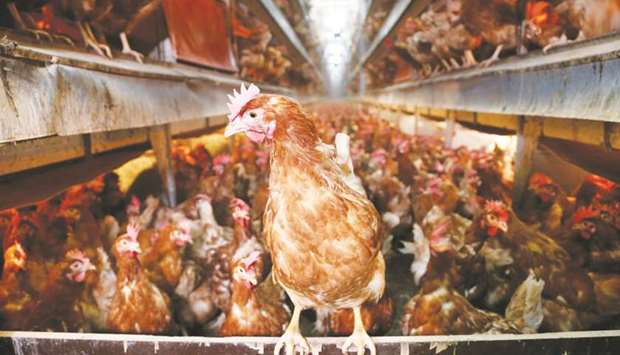
Hens are pictured at a poultry farm in Wortel near Antwerp, Belgium.