


South Africa’s President Jacob Zuma survived a no-confidence motion against him in parliament yesterday by garnering 198 votes to the opposition’s 177 votes as African National Congress (ANC) lawmakers rallied to his support.
There were nine abstentions in the secret ballot.
ANC lawmakers erupted into singing and dancing in parliament even before the speaker of the house announced the result of the vote in favour of the 75-year-old Zuma who has been dogged by allegations of corruption during his eight years in office.
“The motion of no-confidence is ... negative,” Baleka Mbete, speaker of the 400-member parliament, said.
The rand fell by 1% on the announcement of the outcome.
Zuma, who has held power in Africa’s most industrialised economy since 2009 but whose time in office has been marked by allegations of sleaze and influence-peddling, has now survived nine no-confidence votes thanks to loyal backing from lawmakers in his ANC.
Had he lost, he and his entire cabinet would have had to step down.
Mbete had earlier ruled that the vote should – unlike other no-confidence votes Zuma faced – be by secret ballot, a decision the opposition hoped would embolden ANC members who are unhappy with Zuma to vote against him.
Zuma has upset investors, in particular by removing finance minister Pravin Gordhan in March.
The country’s credit rating was downgraded to junk by two of the top three rating agencies, unemployment is at a 14-year high of 27.7% and the economy is back in recession.
Newspaper headlines reflected the high stakes at play.
“JZ’s moment of truth” read The Star, while The Sowetan declared: “High Noon for Zuma”.
If the motion had been successful, Zuma – whose term is due to run until 2019 – would be removed as president but would remain as ANC leader until December, when he is due to step down and a new leader elected in his place.
Should he be forced to quit, the speaker would take over and the National Assembly would be expected to elect a new president within 30 days.
As the largest party in parliament, the ANC would be expected to select the new president and government.
The ANC – once all-powerful as heir of South Africa’s anti-apartheid struggle – has lost popularity under Zuma, underscored by its worst electoral showing in over two decades of power in local elections last year.
Thousands of people took part in protest marches in April calling for Zuma to step down.
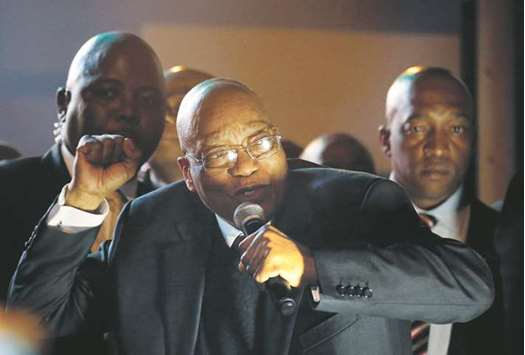
Zuma celebrates with his supporters after surviving the no-confidence motion in parliament.