


An official who helped design the Swiss National Bank’s policy to combat the strong franc raised questions about the long-term sustainability of the approach.
The institution’s strategy of using currency-market interventions to avoid more-negative interest rates can’t be viewed as a viable policy over the long haul, former SNB vice president Jean-Pierre Danthine wrote in a working paper published by the Paris School of Economics, where he heads the board of directors.
“The SNB is already the central bank with the largest balance sheet in relation to gross domestic product,” he said. “One can hardly imagine that it will continue to grow at the same pace over the next 10 years.” He didn’t elaborate further.
Interest rates, on the other hand, can be cut further as long as the SNB takes steps to prevent banks from hoarding cash, Danthine argued, reflecting on a suggestion put forward by the International Monetary Fund. The Washington-based lender proposed last year that the Swiss stop intermittent interventions and cut rates by a “moderate” amount.
The SNB has spent years – and hundreds of billions – countering an appreciation of the franc against the euro, using a cap on its value between 2011 and 2015. Since then, it has sought to maintain an interest-rate differential with the 19- nation bloc via a 0.75% charge on sight deposits and occasional interventions.
SNB president Thomas Jordan affirmed that two-pillar policy in June and has said the central bank has sufficient room to manoeuvre on the balance sheet and cut interest rates further below zero if needed.
“In order to go more deeply negative, the temptation to hoard paper currency at the wholesale level must be deterred,” wrote Danthine, who retired from the SNB just months after the new strategy was put in place.
He confirmed authorship of the paper via e-mail. A spokesman for the SNB declined to comment.
To prevent hoarding, the SNB could levy a fee on cash withdrawals from the central bank, taking into account the depth of the negative rates and potentially also the duration of the policy. If designed as a sufficient deterrent, “in practice it would never be levied,” he wrote.
As a second element, the SNB could increase its exemptions from the deposit charge – currently 20 times banks’ minimum reserves.
That would keep the burden on financial institutions “approximately unchanged” and ensure that the general public continues to be spared from the fee, Danthine said.
The paper is dated April 2017, when the franc was stronger than 1.09 per euro. It has weakened since then amid improving economic prospects for the euro area and broke through 1.15 per euro this week, according to data compiled by Bloomberg. A weaker currency should spur Swiss inflation, lessening the need for any further easing of SNB monetary policy. Some, notably Harvard Professor Kenneth Rogoff, have suggested societies could go cashless, which would make it much harder for people to avoid negative interest rates.
Danthine said the experience of Switzerland suggested such an approach would be “democratically unfeasible.”
“Negative nominal rates are so unpopular that a democratic majority in favour of any legal measure permitting the direct exposure of the person in the street to negative interest rates is unreachable,” he said, referring to Switzerland’s system of direct democracy.
The fact that other countries could take such a step without a popular vote “should not be a source of comfort,” he added.
“It would be very unadvisable for a technocratic institution such as a central bank to adopt radical monetary-policy measures in the face of such widespread popular disapproval,” he said. “Doing so would generate significant risks to its independent status.”
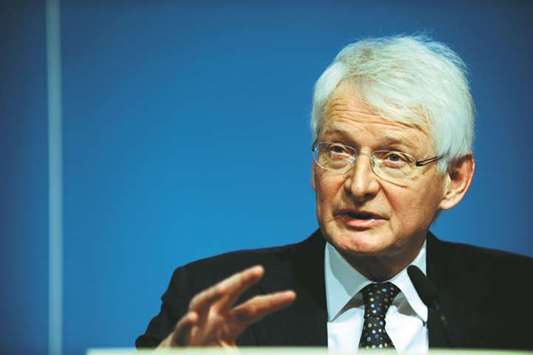
Danthine: Against radical policy measures.