


Veteran Bharatiya Janata Party leader Venkaiah Naidu was yesterday elected India’s next vice-president, boosting Prime Minister Narendra Modi’s political standing.
Naidu, 68, secured 516 parliamentary votes to pip rival Gopalkrishna Gandhi – the 72-year-old grandson of Mahatma Gandhi – who received 244 votes, according to polling officials.
The vice president presides over the Rajya Sabha, the upper house of parliament, and can take temporary charge of the largely ceremonial presidency in the event that the incumbent dies, resigns or is impeached.
Modi congratulated Naidu in a tweet and said, “I’m confident (he) will serve the nation as a diligent & dedicated Vice President, committed to the goal of nation building.”
The BJP and its allies enjoy a majority in the 545-member Lok Sabha, the lower house, but not in the Rajya Sabha, weakening its ability to pass legislation.
The BJP rules 17 of India’s 29 states either directly or in alliance with regional parties.
Naidu’s victory means the top three constitutional offices are now held by BJP leaders following the election of the party’s candidate Ram Nath Kovind as president earlier this month.
Naidu has served as a federal minister with the ministries of urban development and information and broadcasting.
He has also been national president of the BJP.
Naidu succeeds Hamid Ansari, an educator and former foreign services officer, who completes two terms as vice president on Thursday.
Gandhi was fielded by the Congress-led opposition with backing from several parties, including Trinamool Congress, Left, the Biju Janata Dal and the Janata Dal-United.
Gandhi congratulated Naidu on his victory and wished him all the best in his new office.
He hoped Naidu would be vice president of all sections of India.
Gandhi thanked all the parties that supported him and said that the voting figures showed that the numbers that voted for him were “beyond expectations”.
He said the fight in the election was for free thought, free speech, pluralism and secularism.
Soon after his election, Naidu said he as chairman would steer the functioning of the Rajya Sabha “without fear or favour” and uphold its dignity and decorum with the co-operation of all members.
Leader of Opposition in the Rajya Sabha Ghulam Nabi Azad hoped Naidu would give time and opportunities to all leaders and parties to express their views in the way Ansari conducted the House.
Azad and Communist Party of India (Marxist) leader Sitaram Yechury said the fight was between two political trends.
One wanted to strengthen the constitutional order.
Born in 1949 in Chavatapalem in Nellore district, Naidu got a degree from Andhra University College of Law Visakhapatnam.
He was a “swayamsevak” in the RSS and joined ABVP during his college days.
He came to the spotlight for his role in “Jai Andhra” movement of 1972 and became the convener of the anti-corruption Jayaprakash Chhatra Samiti in 1974.
He held street protests against the Emergency.
He served three terms in the Rajya Sabha from Karnataka from 1998 and was elected for his fourth term from Rajasthan last year.
He was a member of the Andhra Pradesh assembly twice in the 1980s.
Naidu was Rural Development Minister in the Vajpayee government between 2000-02.
In Modi’s government, first he was Parliamentary Affairs Minister as well as the Housing and Urban Development.
From Parliamentary Affairs, he was shifted to Information and Broadcasting Minister which portfolio he held till he was nominated as the vice presidential candidate.
Soon after his election, a string of leaders of the BJP and allied parties and ministers went to Naidu’s residence and greeted him.
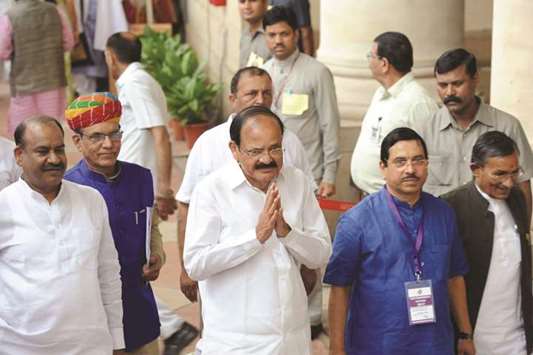
Venkaiah Naidu greets MPs ahead of voting in New Delhi yesterday.