


President M Abdul Hamid has sought the assistance of the Organisation of Islamic Co-operation (OIC) in resolving the Rohingya problem in Bangladesh.
“Provide necessary assistance for repatriation of the Rohingya refugees from Bangladesh,” the President said while OIC Secretary General Dr Yousef bin Ahmad al-Othaimeen paid a courtesy call on him at the President’s Secretariat in Dhaka on Thursday evening.
Abdul Hamid also stressed the need for joint efforts of the Muslim Ummah to resolve the problems of Palestinians and Al-Aqsa mosque issue.
Noting that an excellent communal harmony exists in the country, Abdul Hamid said, “Bangladesh is always ready to help the Muslim Ummah for its overall development and progress.”
The president thanked the OIC secretary general for his outstanding contribution to the welfare of Muslims across the globe.
Lauding the tremendous development of Bangladesh in different sectors, especially in the women empowerment issue, the OIC secretary general said, “The progress in women empowerment in Bangladesh is an instance for others to follow.”
On terrorism and militancy, he said Islam believes in peace and welfare and there is no room for terrorism and militancy.
He said the OIC would take necessary steps so that the Muslim world can lead the science and technology sector in future.
The OIC secretary general hoped that Bangladesh would play a significant role in establishing world peace and harmony.
Secretaries concerned were also present on the occasion.
The OIC secretary general arrived in Dhaka on Wednesday night on a four-day official trip.
It is his first ever visit to Bangladesh since his assumption of office of the Jeddah-based organisation.
During a visit to the Kutupalong makeshift camp in Cox’s Bazar yesterday, Yousef bin Ahmad al-Othaimeen said the OIC and the United Nations are working with Bangladesh’s government to solve the Rohingya refugee crisis.
The OIC, which represents 57 states and acts as the collective voice of the Muslim world, urged the southeast Asian nations to join hands with Muslim-majority neighbours in tackling the refugee crisis.
“We want to see a permanent solution to Rohingya Muslim minority in Myanmar,” said Othaimeen, in Bangladesh on a four-day visit.
Several Rohingya who were victims of military persecution in Myanmar described how they were tortured and abused, and said they wanted to go back and exercise their rights as citizens.
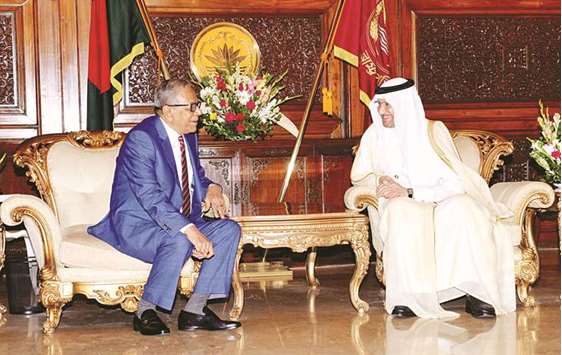
President Abdul Hamid exchanging views with visiting OIC secretary general Dr Yousef bin Ahmad al-Othaimeen at the President’s Secretariat in Dhaka.