


When South Africa’s parliament votes on Tuesday on whether it has confidence in President Jacob Zuma, Stern Vilani will be following the debate closely.
“Zuma is not a good person. Parliament must vote to remove him,” says the company driver, who lives with his wife and two children in a two-room shack in Johannesburg’s low-income Diepsloot neighbourhood.
Rubbish is piled outside his house, which has no electricity and which floods during rains, and like many South Africans, Vilani holds Zuma responsible for his situation.
“He has not done anything to fix our problems,” says the 38-year-old, who regards Diepsloot as his home and does not want to move elsewhere.
Zuma has already survived seven no-confidence votes since he became president in 2009, but this time, the stakes are higher after the Constitutional Court authorised Speaker of the National Assembly Baleka Mbete to make the ballot secret if she wishes.
A secret ballot would allow members of Zuma’s deeply fractured African National Congress (ANC) to vote against him without fear of reprisals, paving the way for his ouster after nearly two years of intermittent demonstrations and calls for him to step down.
Torn between her loyalty to Zuma and nine out of a total of 13 parliamentary parties which requested a secret ballot, Mbete is yet to announce her decision.
The no confidence vote was proposed by the main opposition Democratic Alliance (DA) in April after Zuma fired respected finance minister Pravin Gordhan, prompting two ratings agencies to downgrade South Africa’s credit rating to junk.
The downgrades followed a string of corruption scandals, one of which prompted the Constitutional Court and the Treasury to order Zuma to repay 7.8mn rand ($587,800 in taxpayers’ money he had used to renovate his country home in the village of Nkandla.
Recently, pressure continued piling up on the president after e-mails leaked to the media reportedly revealed extensive ties between him, his allies and the Gupta business family, which the opposition accuses of meddling in government policies to obtain corrupt deals.
Zuma is also under fire over the government’s handling of the economy, which shrank 0.7% in the first quarter following a drought and a slump in mineral prices.
Nearly 28% of the workforce and more than half of young people are unemployed.
Africa’s most industrialised economy has one of the highest inequality rates in the world, with townships like Diepsloot standing in contrast to luxury residential estates such as Dainfern, located nearby, with its golf courses and security walls.
Critics within the ANC see Zuma as having delegitimised the former liberation movement, which led South Africa out of the apartheid era and has governed the country since the first democratic elections in 1994.
The ANC recorded its worst ever results in the August 2016 elections, taking less than 60% of the vote.
For parliament to unseat Zuma, however, at least 50 of the ANC’s 249 legislators would have to vote against him, in addition to all the opposition MPs in the 400-seat assembly.
Only a few ANC legislators have so far dared to voice public criticism of the president, and the party’s Secretary General Gwede Mantashe warned that voting against him would be “the highest betrayal.”
Yet even if only a few ANC MPs dare break with party discipline, “that could be one more element in the build-up of pressure” on Zuma, said Daryl Glaser, political studies professor at Johannesburg’s Witwatersrand University.
Zuma is due to step down as ANC president at a party conference in December.
His future will then depend on who will succeed him, according to Glaser.
The top runners are his ex-wife Nkosazana Dlamini-Zuma, who would likely support him, and his deputy Cyril Ramaphosa, who has criticised him.
The election of Ramaphosa as party leader would weaken Zuma and could even prompt the party to oust him from the country’s presidency before he has served until the end of his second term in 2019, Glaser said.
The opposition is meanwhile expected to pursue its own attempts to remove Zuma, with the far-left Economic Freedom Fighters (EFF)
seeking a parliamentary inquiry into the Nkandla scandal.
Once Zuma is no longer president, the ANC may still win the elections in 2019, but eventually its reputation for corruption and mismanagement could make it lose its majority in 2024, analysts say.
South Africa could then face an unstable era of fragile coalition governments, according to the global risk consultancy Verisk Maplecroft.
Diepsloot resident Khulekani Khanye, meanwhile, could not care less whether Zuma stays or goes.
“President after president – my life does not change anyway,” the 48-year-old street vendor sighed.
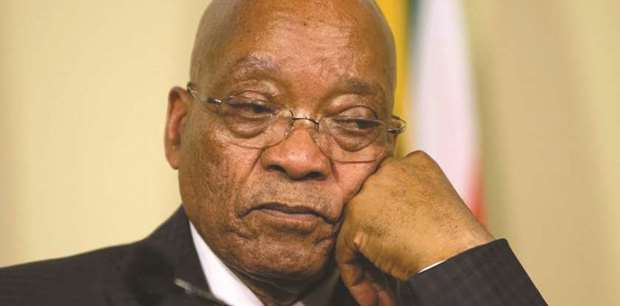
Jacob Zuma