


Copper has finally emerged from its extended winter hibernation, breaking out of an eight-month trading range to hit two-year highs.
London Metal Exchange three-month copper broke through the top of that range at $6,200 last Tuesday and hasn’t looked back since.
This morning it touched $6,430 per tonne, a level not seen since May 2015.
The wake-up call came in the form of news of a potential Chinese ban on some imports of copper scrap.
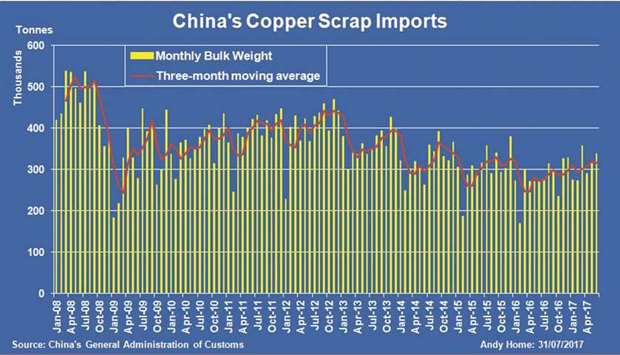
China is the world’s largest importer of scrap metal, sucking in more than 3mn tonnes a year to supplement its copper needs.
The market’s bullish take is that a partial ban will mean heightened demand for imports of copper in other forms, whether mined copper concentrate or refined metal.
The timing of the proposed ban, in late 2018, throws in some additional bullish spice, since there is a broad consensus among analysts that the recent surge in mined production will have dissipated by that stage.
However, although a ban would undoubtedly cause disruption to parts of the global copper supply chain, its impact is unlikely to be as significant as the bulls might wish.
Scrap is an important part of any industrial metal’s supply-demand dynamics, albeit a shadowy one because of a lack of statistical visibility on what is going on in the secondary materials part of the supply chain.
In the case of copper, scrap affects the broader market in two different ways.
It can boost refined metal supply by offering smelter-refineries an alternative feed source to mined concentrates.
And it can impact demand by offering first-stage manufacturers a cheaper feed source than refined metal.
Both of those roles have recently been in play after a surge in scrap availability in the wake of copper’s price rally late last year.
The International Copper Study Group (ICSG) estimates that refined copper production from secondary (scrap) sources jumped by 12% in the first four months of this year.
That more than offset a 2% decline in primary production, which is refined copper produced from copper concentrates.
On the demand side of the equation, it is notable that China’s appetite for imported refined copper has been subdued this year even while imports of scrap have increased. Bountiful scrap has filled the supply gap left by a string of mine disruptions in the first half of the year and acted as a significant price stabiliser.
The process can work in reverse as well.
During periods of sharply falling prices, scrap supply dwindles, acting to reduce secondary production and increase demand for primary metal among fabricators. So what would a Chinese ban mean for copper’s supply-demand dynamics? Much depends on what sort of scrap we’re talking about. The details of the proposed ban are a little vague, but according to an informal notification issued by China’s Nonferrous Metals Industry Association on its WeChat account, the ban would encompass the sort of material covered by the trade code H740400010.
The Chinese define it as “Category 7” scrap and it includes a wide range of products such as cables and motors which need to be physically dismantled and sorted before being processed, often with environmental impact.
It is generally deemed to be low-grade material, typically containing about 14-15% metal. China’s state research house Antaike has estimated that while Category 7 scrap might have accounted for 60-70% of the 3.35mn tonnes of total scrap imports last year, the copper equivalent contained was just 300,000 tonnes.
To put that figure in perspective, China’s imports of refined metal and concentrates last year were 3.6mn tonnes and 17.0mn tonnes respectively.
Moreover, two factors are likely to mitigate any “scrap shock”. First, China’s copper industry has been given at least a year’s notice, allowing plenty of time to accelerate imports and build stocks ahead of the end-2018 deadline. Second, there is nothing to stop this sort of scrap being dismantled outside of China before being imported under a different trade code.
Ultimately this material will not be lost to the market. It will at some stage be processed, even if only partially or not at all in China. And price, ever the driver of the scrap sector, will be the key determinant of how and when it re-enters the supply chain.
The real significance of the proposed ban is more what it says about China’s overall direction of travel when it comes to scrap materials.
As environmental considerations move ever higher on Chinese policy-makers’ agenda, Beijing is shifting away from the treatment of lower-grade materials across the industrial spectrum.
This month it notified the World Trade Organisation it would ban the import of four classes and 24 kinds of “solid wastes” by the end of this year, including a range of textiles, plastics and complex slag and dross from the iron and steel industry.
Andy Home is a columnist for Reuters. The views expressed are those of the author.
CHINA