


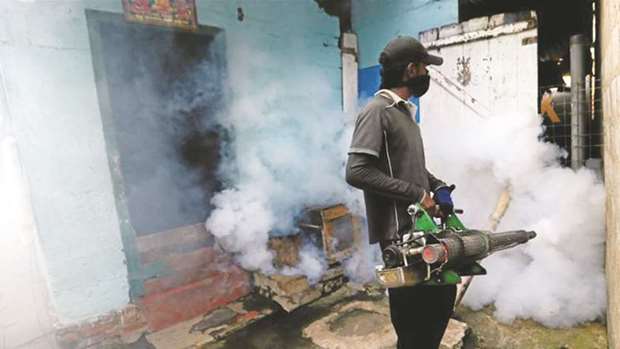
This time they are on the hunt for mosquito breeding grounds.
Their task is to eliminate the hotbeds as part of a campaign to stamp out a deadly dengue virus outbreak, which has claimed about 315 lives this year and sent 113,543 to hospital.
The soldiers are backed by health officials and police, who have the power to haul individuals to court for having the breeding sites around their home, such as stagnant puddles of water.
A penalty of $32 can be imposed on offenders.
Hospitals are overcrowded with patients suspected of having contracted dengue.
The mosquito-borne virus usually spikes soon after the monsoon rains in the tropics and manifests with an onset of fever and severe joint and eye pain.
This year’s outbreak has been the worst in Sri Lanka’s history, with the number of patients
rising day by day.
In contrast, there were 55,000 cases and 108 deaths in all of last year.
Since there is no approved vaccine against the virus, efforts on the Indian Ocean island of 20mn people are focussed on preventing dengue’s spread.
“We need the co-operation of the public to control the spread of dengue. The government has put in all its efforts to control the spread of the disease,” Health Minister Rajitha Senaratne said.
Scenes of two or three people sharing a hospital bed and patients sprawled on the ground have become common.
Some of the hospitals have been forced to restrict admissions.
The Western province, which includes the capital Colombo, has been the worst affected.
Nearly 50% of the country’s dengue cases are from the
region.
But several other districts, including those in southern coastal areas popular with tourists
, have also been hit.
Hospital staff have not been spared, with many of them falling ill and some dying.
“My 57-year-old sister, Anoma, who worked as a clerk at the hospital, died due to dengue, just after two days of fever,” said Anura Dissanayake, who is also an employee at the same hospital in Ragama, 15km north of the capital.
“The employees work in fear as very often workers have been victims,” he said.
Clean-up campaigns have been launched in recent weeks, with even school children enlisted to scour public places, houses, educational institutions and open lands.
The education ministry has advised students to wear long-sleeved shirts or tops along with long pants, instead of the usual school uniforms of short pants and dresses.
A mobile phone company has created an app for citizens to report to authorities the locations of dengue patients and mosquito breeding grounds.
“Despite the continuous cleaning campaigns we find the same location is polluted again and again,” said Doctor Nimalka Pannila Hetti of the National Dengue Control Unit.
One of the biggest impediments to slowing the spread is garbage.
The piles of rubbish littering the roadsides of the capital and its outskirts are a tropical
paradise for mosquitoes.
The capital’s waste management system is in poor condition.
In April, a mountain of garbage collapsed at a landfill outside of the capital, killing at least 30 people.
The impact of the outbreak has gone beyond the grave health consequences and spilled into the economy.
The tourism sector has been hit by several countries issuing travel warnings about the dengue situation in Sri Lanka.
Sri Lanka has appealed to the international community to revise the advisories in light of the decrease in the number of tourist arrivals.
The government has sought international assistance to battle the epidemic.
Australia has stepped in to extend support while the World Health Organization has also
offered help.
Despite the efforts, there is concern the epidemic could intensify with the onset of the next monsoon season.
“With the monsoon rains due again in October we can expect another outbreak of Dengue. We will have to continue the campaigns and be vigilant,” Doctor Hetti warned.