


Chinese financial institutions are gaining greater clout in the international bond underwriting business, in a trend that’s altering the lives of bankers from New York to Shanghai.
For Chen Yi, it’s even meant a quicker-than-expected upgrade to diamond status for his Cathay Pacific Airways frequent-flyer card.
The Hong Kong-based head of debt capital markets at Haitong International Securities Group has been shuttling back and forth to visit clients in mainland China nearly once a week since late last year.
That’s when Chinese authorities introduced new curbs on property financing and steps to slow local credit growth, prompting more developers and other lower-rated firms to look overseas for funds.
The rush of international offerings is helping compensate for shrinking underwriting businesses onshore after the government’s crackdown on leverage pushed up local borrowing costs and crimped debt issuance in yuan.
“As Chinese institutions, we know our clients better than foreign managers,” said Chen.
His team has helped manage $3.1bn in sales this year of high-yield bonds denominated in dollars, euro and yen from companies in Asia outside Japan, the most among all underwriters of such securities and up from a No. 10 ranking for all of 2016.
“In the near future, property developers will still count on the Asian dollar market for financing because the government likely won’t lift the onshore funding bans in the short term,” Chen said.
High-yield issuers from China sold $8.5bn of dollar bonds in the second quarter, the most for any quarter on record, according to Bloomberg-compiled data.
The most-indebted property developer, China Evergrande Group, last month issued an unprecedented amount of notes in one deal in the Asian junk debt market.
China Citic Bank International ranks third so far this year in high-yield securities denominated in dollars, euro and yen from companies in Asia outside Japan, after Haitong and Credit Suisse Group AG. That means two Chinese brokerages are in the top three, compared with none for 2016, data compiled by Bloomberg show.
Among the top 20 underwriters of such securities, Chinese financial institutions hold a 26.2% market share, up from 18.8% for all of 2016, according to the data. Chen at Haitong expects his flight schedule to remain busy in the second half.
He says that China’s high-yield borrowers will likely offer about the same amount of international debt as they did in the first six months of the year, given onshore finance restrictions.
Still, there are headwinds. Yields on junk bonds in dollars from Asian issuers have risen in the past month after a probe on top Chinese dealmakers and a chemical firm’s hidden debt fuelled concerns about credit risks.
The average yield on local five-year corporate bonds with AA-ratings increased 14 basis points this year to 6.21%.
There will likely be a slight slowdown in issuance of dollar bonds from high-yield companies in China, but they will continue to dominate such offerings in Asia outside Japan, according to Terence Chia, head of Asia Pacific debt capital markets syndicate at Credit Suisse.
The bank has helped manage $2.7bn in sales this year of high-yield notes in dollars, euro and yen from firms in Asia ex Japan.
“As an international bank, Credit Suisse offers clients more transparency and market best practice when it comes to deal execution, as well as a strong global distribution platform and access to our global resources,” Chia said.
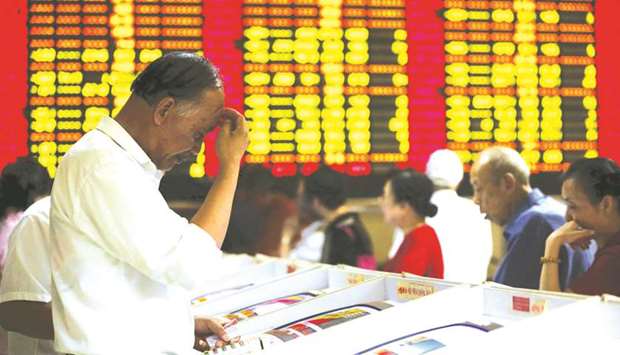
Investors look at computer screens showing stock information at a brokerage house in Shanghai. Chinese financial institutions are gaining greater clout in the international bond underwriting business, in a trend that’s altering the lives of bankers from New York to Shanghai.