


A cut by Rio Tinto Group to its full-year iron ore shipping guidance is set to bolster prices that have rebounded into a bull market on stronger-than-expected demand in China.
Iron ore futures in Singapore surged as the world’s No 2 exporter flagged last week that cargoes from Australia are expected at about 330mn metric tonnes in 2017. That’s down from its April forecast of 330mn-to-340mn tonnes.
“Expectations were too high on supply growth out of Australia,” Daniel Hynes, an analyst in Sydney at Australia & New Zealand Banking Group, said by phone. With record steel production in China “we’re seeing a readjustment on both sides of the market, which is supporting prices,” he said.
China’s imports of iron are on course to comfortably top 1bn tonnes this year as rising steel prices support demand, helping to underpin demand for the raw material even as the top miners continue to raise supply. The recent gain in benchmark iron ore that’s lifted prices may last for some time, according to Barclays.
Rio fell 1.5% to A$64.94 in Sydney trading last week. Forecasts for lower shipments of iron ore and coking coal may trim earnings, Shaw and Partners said in a note.
Iron ore “shipments were impacted by an acceleration in our rail maintenance programme following poor weather,” chief executive officer Jean-Sebastien Jacques said in the statement. Rio also cut its forecast on 2017 coking coal production on the impact of a March cyclone in Queensland state.
Iron ore cargoes have been impacted by lingering effects of wet weather in Western Australia earlier this year, UBS Group analysts wrote in a July 11 note. The state had its wettest summer, which runs December through February, since at least 1900, according to Australia’s Bureau of Meteorology.
Rio shipments from Western Australia declined 6% to 77.7mn tonnes in the three months to June 30, from 82.2mn tonnes in the same period a year earlier, Rio said. That missed the median estimate of 81.8mn tonnes among four analysts surveyed by Bloomberg.
“We’re taking confidence from the price over volumes,” Melbourne-based Morgans Financial analyst Adrian Prendergast said by phone. “There was a real concern when the iron ore price corrected a few months ago, but it’s rebounded much quicker than we expected.”
Output of steel hit a record last month in China as the nation’s gross domestic product topped estimates in the second quarter.
Steel prices have been on a roll and reinforcement-bar futures have surged 27% on the Shanghai Futures Exchange this year.
Rio’s plans to carry out further rail maintenance this half will help improve future productivity, Morgans’ Prendergast said.
Expected slower growth in China in 2018 is seen curbing demand and weighing on iron ore prices next year, according to Westpac Banking Corp. It’s positive to see Rio take “a disciplined approach to supply that seeks to maximise the value of the total reserve base, rather than one which seeks to maximise volume,” Sanford C Bernstein analysts including Paul Gait said a note.
Rio is forecast to produce 328.4mn tonnes in 2017, according to the average among seven analysts’ estimates compiled by Bloomberg. The producer shipped 327.6mn tonnes in 2016.
Rio’s hard coking coal output fell 14% on the impact of damage to infrastructure in Queensland caused by Cyclone Debbie in March, the worst storm to hit the state since 2011. Output of about 1.56mn tonnes missed a 2.1mn tonnes median estimate among four analysts.
The producer cut its forecast for 2017 coking coal production to 7.2mn to 7.8mn tonnes from an earlier estimate of 7.8mn to 8.4mn tonnes following the impact of the cyclone.
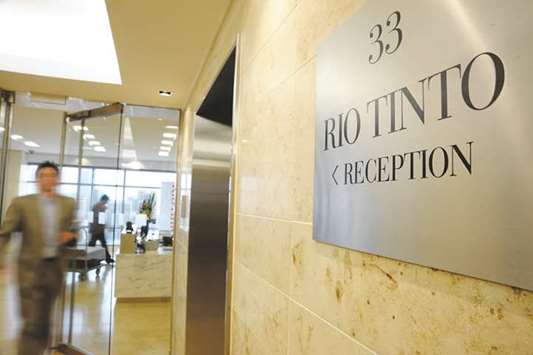
A man walks through the entrance from the reception area of Rio Tinto’s head office in Melbourne. A cut by Rio Tinto to its full-year iron ore shipping guidance is set to bolster prices that have rebounded into a bull market on stronger-than-expected demand in China.