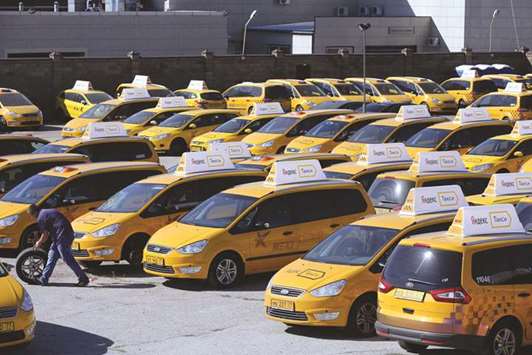
Uber and Yandex, the “Google of Russia”, have agreed to combine their Russian ride-sharing businesses, with Yandex becoming the leading partner in a deal that extends to five neighbouring markets.
The agreement sent Yandex shares rocketing 17% in afternoon Moscow trade yesterday and follows the merger in May of rival Russian taxi players Fasten and Rutaxi.
“With this deal Yandex eliminates an aggressive competitor which, in the long run, will lead to improved monetization and profitability,” said Sergey Libin, an analyst with Raiffeisen Bank in Moscow. “It’s a good deal.”
The deal marks another pullback from Uber’s breakneck global expansion, coming a year after its exit from China.
It does have potential upside for the Silicon Valley online taxi hailing pioneer, based on its 36.6% stake in the merged company.
San Francisco-based Uber has agreed to invest $225mn (13.5bn roubles) while Yandex will contribute $100mn into a new joint company in which Yandex will own 59.3% and employees have a 4.1% stake.
For months Uber has struggled with legal setbacks, accusations of a sexist work culture and driver protests, culminating in the June departure of co-founder and CEO Travis Kalanick under investor pressure.
In a joint statement, Yandex and Uber said they will join forces in Russia, Armenia, Azerbaijan, Belarus, Georgia and Kazakhstan to create a new company operating in some 127 cities, in a deal expected to close in the fourth quarter.
Yandex.Taxi chief executive Tigran Khudaverdyan will become the CEO of the combined business and Yandex will consolidate the new company’s results in its financial statements.
Yandex will hold four board seats, while Uber holds three, they said.
Uber will contribute its UberEATS food delivery business in the six-country region to the new venture.
Diversified internet giant Yandex is the dominant player in Web search, maps and mobile navigation in the region.
Uber said that the merger in Eastern Europe does not imply a strategy of further retrenchment elsewhere.
Indeed, financial terms of the deal make it a lucrative one, it said.
“This is an exciting opportunity in a unique situation and our operations in other countries will not be affected,” Pierre-Dimitri Gore-Coty, the head of Uber in Europe, the Middle East and Africa, said in a blog post addressed to Uber employees.
Gore-Coty said Uber’s 36.6% stake is worth $1.4bn, based on an agreed valuation of $3.725bn for the combined company.
That marks a sizeable gain on the $170mn Uber invested since entering the region three-and-a-half years ago, even with the new $225mn investment.
Uber sold its Chinese business to far larger local rival Didi Chuxing a year ago in return for Uber receiving a 17.5% stake in Didi which was then valued at $35bn.
While Uber no longer exists in China, the paper value of its stake in Didi has risen to around $8bn from $6.1bn, based on Didi’s recent funding round valued at $50bn.
The unified business in Russia and surrounding markets also helps Uber become more sustainable, he said, by helping it cut losses as part of a global drive toward eventual profitability.
Uber reported in late May that its net loss, excluding employee stock options and other items, narrowed in the first quarter to $708mn from $991mn in the fourth quarter.
This week, Uber told investors that losses continued to decline in the second quarter, a source familiar with the report said.
The ownership stakes reflect how Yandex.Taxi is roughly twice the size of Uber in the region.
As of June, Yandex.Taxi had an annual run rate of 285mn rides and gross bookings of $1.01bn, while Uber had 134mn rides and $566mn in bookings, the companies said.
Yandex and Uber compete in Russia with rivals including Fasten/Rutaxi, Maxim and Gett, the Israeli startup backed by German automaker Volkswagen.
Yandex.Taxi, which was founded in 2011, is active in 127 cities across the region.
Uber, founded in 2009, is active in 16 cities in Russia and five cities in Azerbaijan, Belarus and Kazakhstan.
Uber does not now operate in Armenia or Georgia.
Following completion of the deal, passengers will be able to continue to use either Yandex or Uber apps.
The driver apps of the two companies will be integrated into a single app for greater efficiency, they said.
Uber operates in nearly 600 cities worldwide.