


A Bangladesh government critic who alleges he was the latest in a wave of activists and opposition figures to be abducted says he will not be silenced by the ordeal and will continue to campaign against human rights abuses.
Farhad Mazhar, a poet and social activist, claims he was forced into a minibus by three men while walking near his home in Dhaka last week. He was found about 16 hours later in a town more than 200km from the Bangladesh
capital Dhaka.
Report that Mazhar had gone missing was widely reported last Monday amid growing international concern, including from the United Nations, about the number of forced disappearances in Bangladesh, which human rights groups say are mostly perpetrated by the country’s
security services.
“They used some harsh language, took away my mobile and blindfolded me,” he recalled. “They used their knees to keep me pinned down on the floor of the minibus.”
As the clamour over his disappearance grew, police announced they had found Mazhar, 69, aboard a bus near Khulna, a regional city about eight hours’ drive from Dhaka. He has spent the past week recuperating in hospital under police guard.
Odhikar, a Dhaka-based human rights group, estimates about 223 people have been forcibly disappeared in Bangladesh in the past three years. About 18 have been released, but none has spoken on the record about their ordeal.
The silence often extends to the families of the disappeared, including the 31 who have been found dead since July 2014. “Families are scared to talk about it because other members of the family may suffer the consequences,” said Adilur Rahman Khan, a Supreme Court lawyer and the secretary of Odhikar.
Mazhar said yesterday he was unsure who had allegedly abducted him from a street near his home at about 5am last week. “That morning I had had problems with my eyes and so I left my home to buy medicine,” he said.
“Suddenly three men appeared on the sidewalk and they pushed me inside a white
minibus.”
Mazhar says he has no idea who was responsible for his kidnapping. “My abductors were in plain clothes. I don’t know who they were or which group they belonged to,” he said.
“I made several phone calls to my wife while I was captive. Police could locate my position from my calls after the microbus left Dhaka, I found out later. I am surprised why police could not intercept the microbus well before it reached Khulna.”
Mazhar said he was still experiencing “heavy trauma” and would need time to recover. “But I am not afraid to reveal what happened to me,” he said. “People become mysteriously silent after they emerge alive from enforced disappearances. When I return to work I will begin working on this issue. We have to end this culture of enforced
disappearances.”
Police in Dhaka are investigating the case but officers have told local media they are sceptical of Mazhar’s account. One official told the Daily Star yesterday: “We did not find any evidence that he went to Khulna on
a microbus.”
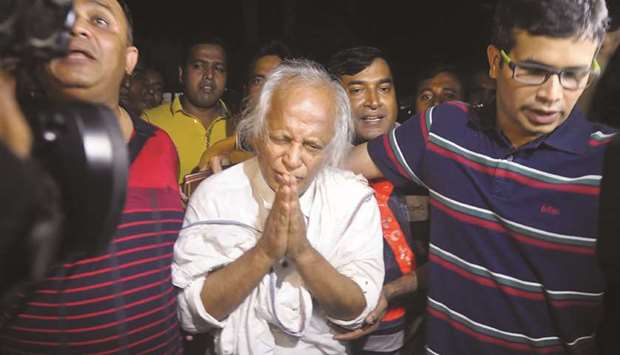
Farhad Mazhar