


Chairmen and directors of both clubs share a meal before each derby, and often greet each other like old friends. It is hard to imagine the same being true in Manchester or Milan.
Some have suggested that the pact is a myth, but when rumours emerged in 2012 of Real making a move for Atletico’s Radamel Falcao, their then-manager Jose Mourinho explained that “there is a non-aggression pact. I think it’s a forbidden subject.” When Antoine Griezmann was asked about a potential summer switch earlier this year, he said “Madrid is impossible compared to my club. I believe that they have a pact between them.”
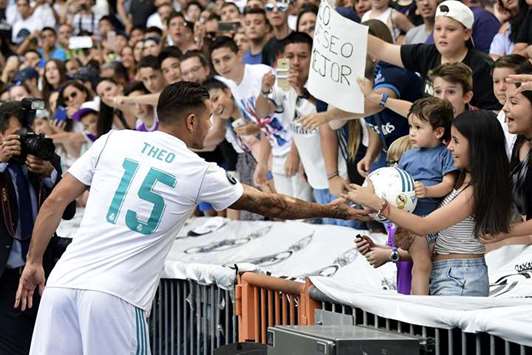
So when Real Madrid announced last week that they had signed Theo Hernandez from Atletico for an initial €24mn, there were a few raised eyebrows. Admittedly Hernandez might not be regarded a first-team regular; indeed – unlike his father Jean-Fracncois and brother Lucas – who made 24 appearances for Diego Simeone’s side last season – the 19-year-old has never made a competitive appearance for Atletico despite being with the club since the age of 11.
But after last year’s breakthrough season on loan at Alaves, there is no denying that the deal is not without significance, and is seen in many quarters as the most important transfer between the two clubs since Hugo Sanchez’s move to the Bernabeu in 1985. It is certainly the most expensive.
So why did Atletico let him go? In truth they had little choice, owing to a release clause in Hernandez’s contract. After he “repeatedly rejected the proposals to renew” – according to a bitter statement from Atletico – and attracted interest from others including Manchester City and Barcelona, his agent Manuel Garcia Quilon made it clear in May that he wanted to sign for Real. Gentleman’s agreement or not, Atletico had no choice but to sell, even to their local rivals, although according to reports in Spain, Real have added more than €2.5mn to the transfer fee in performance-related bonuses – something they were not obliged to do – as a gesture of good will to their neighbours.
Prior to the beginning of last season, Hernandez had not even made his professional debut. On his right hand, he has recently tattooed five numbers, one on each of his fingers, and one on his thumb – 28816 – to remind him of the date that he did grace La Liga for the first time, on 28th August 2016. That professional debut with Alaves was a drab 0-0 draw against Sporting Gijon, but Hernandez has since admitted “I’ll remember it for the rest of my life.” In his second game, he helped Alaves to a famous 2-1 over Barcelona at the Camp Nou. “I thought that playing in the first division would be a bit harder,” he has since admitted.
That tattoo is a daily reminder as to how far Hernandez has come in such a short space of time. It will serve him well among his new superstar teammates to keep a sense of humility and retain the work ethic which has catapulted him from relative obscurity to one of the most exciting players in Europe. Off the pitch he can appear shy. His manager at Alaves last season, Mauricio Pellegrino, now at Southampton, protected him somewhat from the spotlight, and even likened him to “a child”. But there is no hiding at the Bernabeu.
Physically at least, Hernandez appears already fully grown. Standing at 6ft1in, he is strong in the air and the tackle, but it is his pace that sets him apart: his long legs mean he has a preposterous stride and top speed. Often the only thing to stop him is the byline – the only defender to make more successful dribbles in La Liga last season was Atletico’s Filipe Luis.
In many regards, he is not too dissimilar from a young Gareth Bale, a raw, attacking left-back that loves to get forward.
Many times this season he has left defenders for dead in the way the Welshman has become famous for, seizing on a loose ball and then simply setting off. On one occasion against Barcelona in February he ran the length of the pitch, leaving defenders in his wake, only to be foiled by Marc-André ter Stegen.
No doubt he is relishing the prospect of playing with Bale, as well as learning the finer subtleties of his role under the world’s best left-back, Marcelo. Hernandez will get plenty of opportunities to deputise for the Brazilian with Fabio Coentrao moving on to Sporting Lisbon on loan, and he could also play further forward as a left winger if necessary.
His left-foot is a potent weapon, fizzing crosses and set pieces into the box. In the Copa del Rey final against Barcelona, he scored a delicious direct free-kick to level the scores, a dipping effort that found the top corner from 25 yards out. Equally, against Real Madrid in October he was a menace, providing an excellent assist to give Alavés the lead.
Hernandez’s rise has not been without incident. Last month he was accused of sexual assault in Marbella – released without charge – after going AWOL from France Under-21 duty. Eligible for both France and Spain, it is thought he has now chosen to represent the latter internationally, despite representing France at every age group since the Under-18s, a decision that has reportedly left France officials furious.
On the pitch as well, there is a discipline problem: Hernandez’s eagerness often gets the better of him. He received 14 yellows and two red cards in 38 appearances last season, meaning that in 39% of matches he went into the referee’s notebook. Room for improvement then, but it is easy to see why Real Madrid paid up, why they handed Hernandez a whopping six-year contract, why president Florentino Pérez showered him with complements at his official unveiling on Monday evening at the Bernebeu.
The fee of €24mn looks a snip for a player that has all the tools to become the world’s best full-back. What is less clear is that if this is the beginning of a new era between Real and Atletico. Previously Los Blancos steered clear of signing Atlético’s finest players.
Time will tell as to whether the Hernández’s deal is an isolated incident because of his release clause and the fact he made his name away from Atlético, or if the two clubs’ gentleman’s agreement is now dead.