


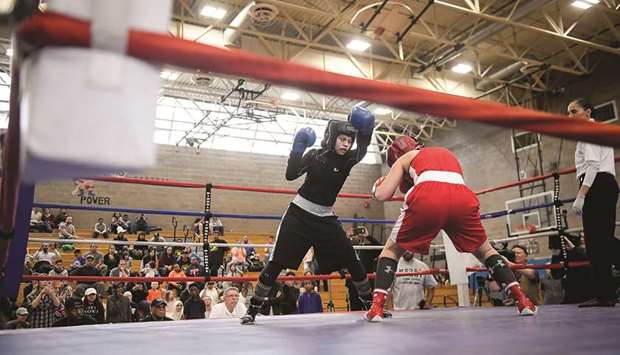
She won a three-round fight by decision, improving her career record to 1-1.
“The second fight I could showcase my skills better,” she said. “That’s how I’ll actually look when I fight.”
Her debut fight was a blur of emotions, an event that attracted national headlines, a horde of news media and raucous supporters that screamed so loudly that Zafar could not hear instructions from her corner.
Zafar, a 17-year-old Muslim from Oakdale, Minn., finally prevailed in a two-year dispute with USA Boxing and made history by becoming the first fighter to wear a hijab, long sleeves and leggings in a sanctioned bout.
She lost her fight but scored a larger victory by opening doors for other Muslims in the United States to compete in sanctioned matches by receiving a religious exemption waiver.
Zafar is aiming higher now, determined to compete in the 2020 Olympics in Toyko, which would require the International Boxing Association to allow competitors to wear hijabs.
“If we can get that rule changed,” she said, “then absolutely I can make it to the Olympics.”
USA Boxing previously cited safety reasons in banning her from wearing her hijab in the ring. Zafar faced a difficult personal decision: Remove her hijab to fight, or never compete in a sanctioned bout.
She questioned why she had to make that choice.
“Two things never went through my head: I never thought of quitting boxing, and I never even thought of taking my scarf off, my hijab,” she said. “I love boxing with my whole being. And I love my hijab. This is part of me. I wouldn’t take it off for anything.”
She picked up boxing at age 13 after her father, Mohammad, suggested she try fencing. Her response: “I would rather get punched in the face than fence.”
She had little interest in other sports and says she’s terrible at throwing any kind of ball.
“I can throw punches,” she noted.
She weighed a wafer-thin 90 pounds when she walked into a boxing gym for the first time. She never wanted to leave.
“I was like, Oh my gosh, this is it,” she said. “I saw pros sparring and thought, this is what I want to do for the rest of my life.”
She trains at Circle of Discipline boxing gym in Minneapolis. The gym has become her second home. Daily hours of operation are 4 to 8pm. Her coaches half-joke that Zafar’s hours at the gym are 3:30pm to 8:30pm.
She believes that every emotion inspires a trip to the gym. Happy? Go to the gym. Sad? Go to the gym. Angry? Definitely gym time.
“When she’s sick, she’s like, I need to go to the gym and work it out,” said her mom, Sarah O’Keefe-Zafar. “Most people think you rest. She’s like, no I need to sweat it out.”
Other boxers initially referred to her as petite and shy, her mom said. Now she spars mostly with men and helps train younger kids. During a recent interview outside Circle of Discipline, she stopped an answer mid-sentence to encourage a young boy who finished a training run by walking the final 20 yards.
“Hey, finish that with a sprint,” she yelled.
Zafar’s mom says boxing has shaped her into a confident young woman.
“With boxing she owned her space,” said O’Keefe-Zafar, a Minnesota native who converted to Islam 17 years ago. “That is powerful for girls and women to see. It’s really not about your size. It’s about your energy.”
Zafar admits she has faced backlash. One man told her that if she loved boxing, she would respect the rules and not try to change them. Internet posters have been particularly cruel.
One person on Twitter asked if Zafar’s opponent will be charged with a hate crime if she knocks off Zafar’s hijab.
“That’s dumb,” she said.
Once, when she was 15, she read something online that questioned whether she is a “real Muslim” because she wears shorts and leggings.
“That hurt a little bit,” she said. “But then I was like, I don’t even know this person. It doesn’t matter what they think.”
Her goal, she said, is simple. She wants to do something she loves.
“I just want my chance too,” she said. “Why am I different than any other girl that wants to fight? It doesn’t hurt you for me to wear this piece of fabric. And it doesn’t hurt my opponent. And it certainly doesn’t hurt me.”
She was at home in March when her boxing coach called with news. USA Boxing cleared her to fight. Zafar was quiet at first, hoping she heard correctly. Then she started screaming.
“I want to fight tomorrow,” she said.
She had to wait until late April, when she participated in an event at the Richard R. Green Central Park School in Minneapolis. She told friends it was the biggest day of her life.
She was flooded with media requests leading into the fight. She also dealt with a cold, on top of being incredibly nervous.
She didn’t feel like herself in the ring and lost by decision. She fumed when she watched her fight back on video.
“I could have done better,” she said.
She’s scheduled to fight again in Kansas City in late July. She said sparring vs. boxing in a real bout is “crazy different. I’ve learned so much.”
Her impact outside the ring continues to expand, too. Zafar learned of a Muslim girl in Texas who made her boxing debut a few weeks ago. Zafar contacted her via Facebook.
The girl told Zafar that she had planned to quit boxing if she wasn’t allowed to wear her hijab.
“She told me, ‘Thank you,’ “ Zafar said. “She said you are special. That’s why I did it, so that other girls could fight too.” –Star Tribune (Minneapolis)/TNS