
Expecting the diplomatic crisis between Doha and the siege countries to be “short-lived”, BMI said Qatar’s consumer spending is expected to expand 3.2% this year against 2.8% in 2016.
“Despite uncertainty from the current diplomatic rift with its regional peers, we still expect an agreement to be reached, most likely via the US mediation… We maintain a positive outlook for consumer spending over our forecast period to 2021,” it said.
In local currency terms, consumer spending would grow at an annual average of 7.2% to QR150.7bn in 2017-21.
Finding essential purchases to occupy a “significant” share of household expenditures, BMI said housing and utilities would account for 32.3% of total in 2017. Food and non-alcoholic drinks would constitute another 13.8%.
BMI said essentials spending in Qatar would remain unchanged, accounting for 67.4% of total in 2017-21 with housing costs continuing to dominate household budgets. The proportion of spending on housing and utilities would remain unchanged at about 32% of total.
Highlighting that food and non-alcoholic drinks as the second largest expenditure for consumers, accounting for 13.8% of total spending, BMI estimates that it would be worth QR15.5bn in 2017, rising to QR21bn by 2021. The sector is expected to see 7.5% growth in 2017-21.
Spending on food, which make up around 92% of headline food and non-alcoholic drinks, is forecast to total QR14.4bn this year and that on non-alcoholic drinks at QR1.2bn. Both are expected to show robust growth in 2017-21, with spending on food estimated to grow 7.4% and non-alcoholic drinks by 8.1%. Qatar is heavily reliant on food imports (which account for over 90% of consumed).
Spending on clothing and footwear, which accounts for around 6.2% of total household budget, is projected to be QR7bn in 2017. “We forecast spending in this category to rise to QR9.2bn by 2021, driven by demand in the large 20-39 years age bracket, which dominates the population in Qatar; and in the $50,000-plus income bracket, where demand for luxury items is likely to increase more rapidly,” it said.
Finding that spending on household goods is developing rapidly on high levels of immigration, BMI said it is expected to reach QR6.4bn in 2017 with those on home appliances to be QR2.3bn, furniture and furnishings (QR1.8bn) and on glass, tableware and utensils (QR1.4bn).
“We forecast spending on household goods to grow by an average 6 .7% between 2017 and 2021 (to reach QR8.4bn),” it added.
Spending on personal care, which is a major component in Qatar’s retail industry, is slated to touch QR4.6bn in 2017. The sector is forecast to grow 10% over 2017-21.
By 2021, spending in this category could be QR6 .8bn, it said; adding personal care would continue the bulk of the sectoral spending, making up about 67% (QR3.1bn in 2017), and indicating strong opportunities for retailers in this sector.
Business / Eco./Bus. News
Consumer spending in Qatar expected to expand 3.2% this year against 2.8% in 2016


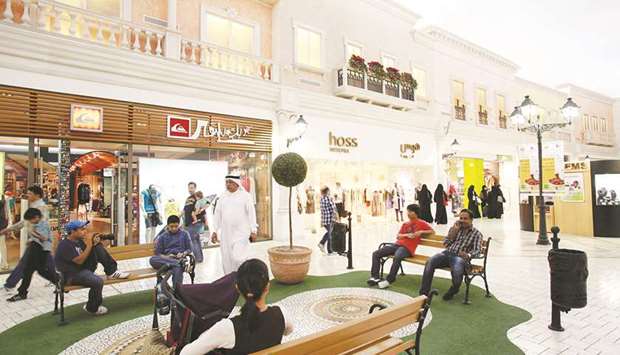
Visitors wait on benches outside retail stores at Villaggio Mall in Doha. In local currency terms, consumer spending in Qatar would grow at an annual average of 7.2% to QR150.7bn in 2017-21, BMI says.