


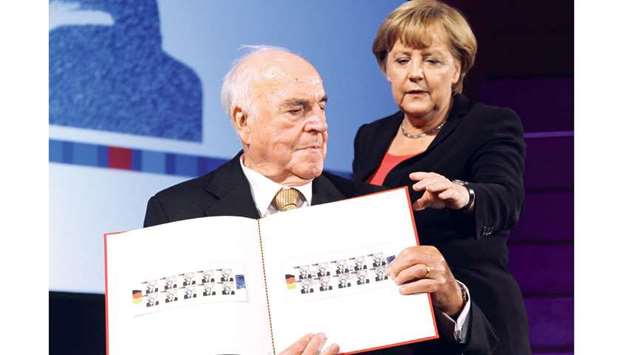
The mass-selling newspaper Bild reported that Kohl died at 9.15am yesterday in bed at his home in Ludwigshafen, in western Germany, with his second wife, Maike Kohl-Richter, at his side.
Merkel, Germany’s incumbent chancellor who grew up in communist East Germany before being appointed by Kohl to her first ministerial post, said that he “changed my own life path decisively” by reuniting Germany.
“When a new spirit began to stir in eastern Europe in the 1980s, when, starting in Poland freedom was seized, when brave people in Leipzig, East Berlin and elsewhere in East Germany began a peaceful revolution, then Helmut Kohl was the right man at the right time,” added Merkel, wearing black.
“He stood fast to the dream and aim of a united Germany even as others hesitated,” she said in a televised statement from Rome.
Merkel told reporters Kohl had displayed “exemplary statesmanship in the service of people and peace”.
“Helmut Kohl therefore became a stroke of luck for us Germans,” she said.
“I am personally very grateful that he was there,” Merkel added, emphasising the role he played helping her into front-line politics.
Germany’s longest-serving post-war chancellor from 1982 to 1998, Kohl was a driving force behind the introduction of the euro currency, persuading sceptical Germans to give up the deutschemark, a cherished symbol of the “economic miracle” of the 1950s and 1960s.
An imposing figure who formed an unlikely personal bond with socialist French president Francois Mitterrand in pushing for closer European integration, Kohl, a conservative, had been frail and wheelchair-bound since suffering a bad fall in 2008.
By committing to anchor Germany within Europe under a common currency, he overcame resistance to reunification from Mitterrand, Soviet leader Mikhail Gorbachev and Margaret Thatcher, the British prime minister who feared the return of a powerful, united Germany.
“The maker of a united Germany and Franco-German friendship: with Helmut Kohl, we lose a great European,” tweeted French President Emmanuel Macron, with an iconic picture of Kohl and Mitterrand holding hands at a memorial to the World War I battle of Verdun.
Shortly after leaving office, Kohl’s reputation was tarnished by a financing scandal in his centre-right CDU, now led by Merkel.
Until his death, Kohl refused to identify the donors, saying that he had given them his word.
Tributes poured in from around the world.
Former US president George H W Bush said that he and his wife Barbara “mourn the loss of a true friend of freedom, and the man I consider one of the greatest leaders in post-war Europe”.
“Working closely with my very good friend to help achieve a peaceful end to the Cold War and the unification of Germany within Nato will remain one of the great joys of my life,” he added in a statement. “Helmut was a rock.”
Former US president Bill Clinton said: “He was called upon to answer some of the most monumental questions of his time, and in answering them correctly he made possible the reunification of a strong, prosperous Germany and the creation of the European Union.”
The view was echoed by German Foreign Minister Sigmar Gabriel.
“A truly great German and above all a truly great European has died,” he said in a statement.
The Kremlin said Russian President Vladimir Putin had sent condolences to Germany’s president and to Merkel and cited him as saying that Kohl “will be remembered in Russia as a resolute supporter of friendly relations between our countries”.
In Brussels, European flags were lowered to half-mast in tribute.
European Commission President Jean-Claude Juncker, who served as Luxembourg’s prime minister while Kohl was in office, tweeted: “Helmut’s death hurts me deeply. My mentor, my friend, the very essence of Europe, he will be greatly, greatly missed.”
He added: “Helmut Kohl filled the European house with life – not only because he built bridges to the west as well as to the east, but also because he never ceased to design even better blueprints for the future of Europe.”
At home, Kohl is celebrated above all as the father of German reunification, which he achieved after the November 1989 fall of the Berlin Wall.
He won voters in bleak communist East Germany by promising them “flourishing landscapes”.
Kohl, along with former European Commission chief Jacques Delors and Jean Monnet, founding father of the European project, are the only three people the EU has made Honorary Citizens of Europe, an honour bestowed for extraordinary work to promote European co-operation.