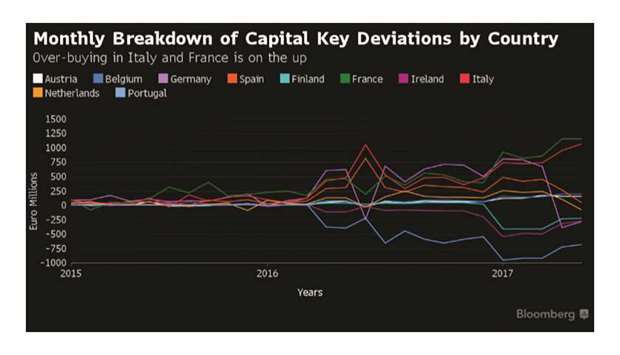
Mario Draghi’s dovish tone last week doused all speculation of the European Central Bank (ECB) tapering its bond purchases anytime soon. The biggest gainers from prolonged quantitative easing could be French and Italian debt, if recent buying patterns are anything to go by.
The ECB has been fudging its own bond-buying guideline known as the capital key, which requires purchases to be broadly in line with the size of each economy, to tilt the program toward picking up larger amounts of what’s more available.
Bloomberg calculations based on ECB data show the central bank has bought too much in France and Italy, countries with relatively large outstanding debt, while falling short on Finland, Ireland and Portugal.
There appears to be limited prospect for a change in the trend. ECB President Draghi said last week that the program has “enough flexibility.”
Executive board member Benoit Coeure said in an interview on May 18 that policy makers have respected bond-buying constraints, “particularly the issue and issuer limits, which matter a lot for the Governing Council,” signalling little appetite for changes and suggesting capital-key deviations will continue.
At the June 8 meeting, the ECB lowered inflation forecasts across the next three years, reducing the 2019 projection to 1.6%, a level seen by many in the market as more consistent with policy easing.
That’s challenging expectations of QE reductions starting in 2018, instead making a more gradual tapering or continued buying more likely. Such a prospect is seen as more supportive of Italian and French bonds, should recent purchasing patterns persist.