


The government will delay by “a few days” the presentation of its programme in parliament following its setback in the general election last week, the BBC reported yesterday.
The pageantry-filled ceremony, officially the State Opening of Parliament but more commonly known as the Queen’s Speech, is an outline of the government’s policy proposal read by Queen Elizabeth II.
It had been scheduled for June 19 and has been in the Queen’s diary since April.
A spokesman for Prime Minister Theresa May refused to confirm the date at a daily briefing, saying only that there would be a statement regarding the Queen’s Speech “in due course”.
The spokesman added that any update would come from Andrea Leadsom, the government’s new representative in the House of Commons.
Conservative leader May lost her parliamentary majority in the election, and ministers have said the government will have to jettison key parts of its manifesto ahead of the Queen’s Speech.
May is trying to strike a deal with Northern Ireland’s Democratic Unionist Party to have the support of its 10 MPs in parliament.
The speech is normally followed by days of debate and then a vote on the government’s programme, which would in effect be a vote of confidence in the government.
“We are working with the DUP in order to reach a deal that will allow the safe passage of the Queen’s Speech,” May’s spokesman said.
The State Opening involves the Queen reading out the government’s policy plans from a calfskin parchment in an annual tradition dating back to the Middle Ages.
Earlier May’s spokesman said Britain’s plan for leaving the European Union has not changed despite the disastrous election gamble that has plunged British politics into chaos days before formal Brexit talks begin.
May failure to win a majority in parliament has prompted calls for her plan to leave the EU’s single market to be watered down, and for some rival lawmakers to demand that the Brexit process be delayed.
“Our position is clearly set out, it is clearly set out in a number of places and there has been no change to that,” May’s spokesman said, adding that the Brexit minister David Davis had set out the same position earlier yesterday.
“Obviously there will be discussions in cabinet but he (Davis) also set out very clearly that we have set out our plans clearly and there is no change to those.”
The election result forced May to search for a deal with a small party of Northern Irish politicians, the Democratic Unionist Party (DUP), to prop up her government and vote through vital legislation.
“The talks are ongoing with the DUP, good progress is being made,” the spokesman said.
The spokesman said May was still committed to completing the Brexit process inside two years, as originally planned, and that Britain would still be prepared to walk away from negotiations without a deal if necessary.
“Our position remains that we want to get the best possible deal for the United Kingdom, we are confident of doing that but of course what you wouldn’t wish to do is to agree to anything which would be harmful to the interests of the whole United Kingdom,” he said.
“We are confident of securing a deal which is good for the whole United Kingdom. You obviously wouldn’t want to accept a deal which was worse than leaving without a deal.”
May plotted election ‘two weeks before its announcement’
London Evening Standard/London
Theresa May was secretly discussing the election up to two weeks before she supposedly decided to call it during a walking holiday in Wales, senior Tories have told the Evening Standard.
The account sits uneasily with No 10’s insistence that the election decision came as a bolt from the blue to Downing Street staffers when May and husband Philip returned from hiking in Snowdonia.
According to a source in the campaign team, it became clear once the snap election was announced that planning sessions had already taken place at No 10.
“The PM and her advisers had held meetings and were starting to plan about 10 days or two weeks before Easter,” said the source.
A No 10 source declined to comment, saying: “We are not going to rake over old ground.”
It also emerged that Brexit Secretary David Davis, who “strongly” pushed for a snap election, had backing from Chancellor Philip Hammond — who felt an early polling day would be insurance against the economy taking a downturn during Brexit talks.
Ironically, Hammond found himself among ministers sidelined in a campaign that centred on the prime minister.
The banishing of Cabinet members from the airwaves was a source of resentment. A minister said: “I wanted to be out there explaining my programme and stopping my Labour shadow getting a free ride on the Today programme, but I was not allowed.”
A campaign source said the decision about who went on TV and radio was taken by Fiona Hill and Nick Timothy, May’s co-chiefs of staff who resigned on Saturday following demands for their heads from MPs and ministers.
“It was impossible to get the economy up as an issue when they had ruled that the chancellor could not be allowed on the radio,” said the source. Insiders say the “closed doors” style of decision-making by May and her two aides led to poor strategy. “David Cameron always had his brightest and best in the room with him — sometimes too many of them, and it became like an Oxford common room,” recalled a veteran. “But that was better than decisions made behind closed doors.”
The reduced influence of Sir Lynton Crosby, the Australian campaign expert who masterminded the 2015 victory, was evident in “confused messaging”, according to a former 2015 aide.
“On one hand we were asking who do you trust to negotiate Brexit, which was exactly the sort of question that Crosby would say should be in the voter’s mind as he or she puts their cross on the ballot paper,” said the former No 10 staffer. “But along came this social reform agenda from Nick Timothy that raised a whole series of new questions, including ones that scared our supporters.”
The disastrous manifesto, with its combination of fox-hunting, winter fuel allowance cuts and the so-called dementia tax, “scared the living daylights” out of traditional Labour supporters who had been on the verge of giving May a chance. Moreover, the lack of a ceiling on care fees horrified natural Tories including elderly people and homeowners who felt they had a right to leave their houses to their children. “People who had been willing to take a look at voting Tory just turned away,” said a campaign insider.
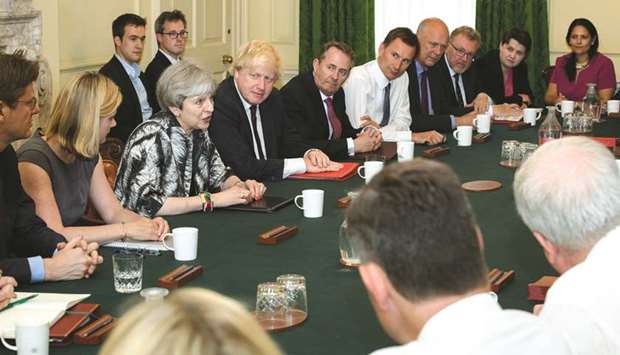
Prime Minister Theresa May holds the first Cabinet meeting following the general election at 10 Downing Street, in London yesterday.