


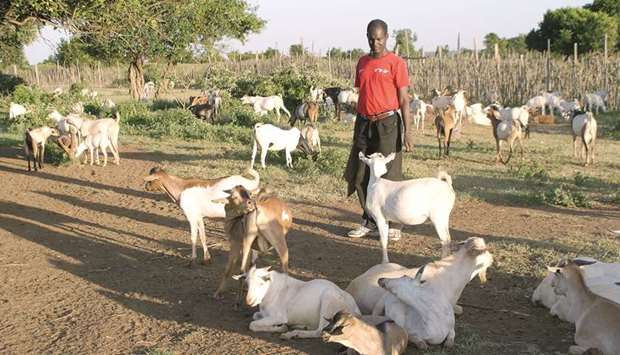
The animals are the most precious possessions of the village’s semi-nomadic Samburu people. Some of them belong to Losenge, though he can’t differentiate between his and those belonging to the other villagers. Nor does he know how many he has.
For the Samburu, his lack of knowledge is a sacrilege. “They think I’m not very intelligent,” he says, smiling, but with a hint of shame. “They think I’m losing my identity if I don’t know my animals.”
Losenge, 45, is a professor of horticulture in the Kenyan capital Nairobi, around 500 kilometres away from Ngeriyoi, which consists of seven mud huts and has no electricity or running water. Nor does it have a school, a hospital or even tarmacked streets.
There are no goats or sheep grazing on the lawn at Losenge’s campus house at the Jomo Kenyatta University of Agriculture and Technology, where he is researching cures for crop diseases, currently focusing on tomatoes.
Losenge was the first member of the Samburu tribe to gain a doctorate, and the first to become a professor.
There are around 360,000 Samburu, closely related to the Massai, possibly Kenya’s most well-known people.
When Losenge was young, Catholic missionaries opened the first school in the area near his village, he says, and every family had to send a boy to be educated.
Lozenge’s father, who was himself illiterate, chose the worst goatherd from among his sons: Losenge. “All the young boys had to herd the goats, but I never liked it,” he recalls. “It was exhausting having to run after the animals.”
The school became his refuge and it quickly became clear to him that education was the only way to avoid becoming a full-time goatherd.
He was chosen to study horticulture – the allocating of subjects to students is normal in Kenya, which subsidises education at state-run universities. At first Losenge had no idea what horticulture was, but he soon began to enjoy it.
For Losenge, it would have been impossible to marry an uneducated woman. His wife, Susan, also of the Samburu tribe, is a finance expert with a Master’s degree. The couple have three small sons.
Over the past 20 years, the Samburu have been increasingly keen to gain a university education. Today there are six Samburu doctors, including two women, according to Philip Leturuju.
The 30-year-old doctor practises medicine in the capital of his home region, Maralal. Most of his colleagues are around his age. “The times in which we just herded goats are over,” he says.
Even today, many people in Losenge’s village are not sure what a university is. People talk of him as a “teacher in the city.”
And they shake their heads, because to them it seems he doesn’t earn enough money to be able to buy himself a large herd of cattle.
Nevertheless, after starting out in life as an unpromising goatherd, Losenge has become a scientist who works with German universities, spent two years researching in the United States and has a life tenure at Jomo Kenyatta University.
“I like coming home to the village,” he says. “But people expect too much of me. Everyone asks me for money. But I’m already paying school fees for several families.”
Losenge left Ngeriyoi behind for a modern world, but at the same time he wants the acceptance of the Samburu, because they are his roots.
“I’ve never regretted deciding for education,” he says. “I’m proud of what I’ve achieved and happy to be connected with both the academic and the traditional worlds.” – DPA