


The three militants who killed eight people after driving a van into pedestrians on London Bridge and then attacking nearby revellers had initially tried to hire a 7.5 tonne truck, the head of the UK capital’s counter-terrorism unit said on Friday.
Commander Dean Haydon also revealed that the men had a stockpile of petrol bombs in the back of their van and carried out their deadly attack with pink ceramic knives.
The discoveries, especially of the plan to hire a truck, suggested more could have been killed.
“Getting hold of a 7.5-tonne lorry — the effects could have been even worse,” Haydon told reporters.
Although Islamic State militants have claimed responsibility for the attack, Haydon said there was no evidence the attackers — Pakistani-born Briton Khuram Butt, Italian Youssef Zaghba and Rachid Redouane who had links to Libya, Morocco and Ireland — were directed by anyone else, either in Britain or abroad.
“We’re not looking for a wider network,” said Haydon, head of London’s Counter Terrorism Command, adding that officers were still trying to piece together how the three men had met. “How did they know each other? They are a diverse bunch,” he said.
Haydon provided unusually extensive details of last Saturday’s attack, the deadliest in London since suicide bombers killed 52 people on the city’s transport network in 2005.
On Saturday morning, Butt, who Haydon said was believed to be the ringleader, tried to rent a 7.5-tonne truck but did not provide payment details.
It was not clear why he could not pay, or if he lacked the necessary licence to drive such a vehicle.
But his attempt echoed last July’s attack in Nice, France, when a 19-tonne truck was driven into crowds, killing 86 people.
Shortly before 1700 GMT, Butt received a text message confirming his hire of a Renault van instead.
At about 1730 GMT, the men drove to pick up the van before heading to Zaghba’s home in east London.
At 1838 GMT they left and two hours later the van reached London Bridge which they drove along twice before targeting pedestrians on the sidewalk on their third run.
Three people on the bridge were struck and killed by the van, believed to have been driven by Butt, before the men abandoned the vehicle and began to attack people in bars and restaurants in the nearby bustling Borough Market area.
The men were armed with identical 12-inch pink ceramic knives, strapped to their wrists with leather bound around the handle.
They were also wearing fake suicide belts — plastic water bottles wrapped in duct tape.
Eight minutes after police were alerted, armed officers arrived at the scene and fired 46 rounds, killing all three men.
Their victims were three French nationals, two Australians, a Canadian, a Spaniard and a Briton.
In the attackers’ van detectives found 13 wine bottles, filled with lighter fuel with rags wrapped round them to make Molotov cocktail petrol bombs.
There were also two blow torches which Haydon thought could have been used to light the homemade bombs as part of a possible secondary attack.
“They were still fairly close to the van. There is a possibility that they could have come back,” Haydon said.
There were also office chairs, a suitcase and two bags of gravel which Haydon said might have been to add weight or to act as a cover story for their activities to friends and family.
He said Redouane’s home, an apartment in Barking, east London, was the men’s safe house where they put their plot together and prepared the attack.
Haydon said since last Saturday they had taken 262 statements from people from 19 different countries and numerous international inquiries were ongoing relating to the attackers and the victims.
British police and security services were criticised after it emerged that they had known about Butt, who featured in a TV documentary entitled “Jihadis Next Door”, in which he joined a group unfurling an Islamic State (IS) flag in a park.
Haydon acknowledged that Butt had links to Al Muhajiroun, a banned group headed by cleric Anjem Choudary.
He was jailed last year for encouraging support of IS, which has been linked to numerous militant plots in Britain and abroad.
Butt was also arrested for fraud last October but was about to be told by prosecutors he would face no further action.
“We will be looking at intelligence and our processes, and asking ourselves the question: ‘Could we have prevented such an attack?’,” Haydon said. “There is nothing that I’m seeing at the moment that suggested that we got that wrong.”
Police have installed security barriers running alongside the sidewalks at eight bridges across the River Thames, and Haydon said similar protection was being considered at other locations.
Police were also reviewing security at “iconic sites”, crowded places and major events, and refreshing advice to theatres, bars, shopping centres and sports venues.
London will not be cowed by militants who have killed 35 people in three separate attacks in Britain, but police will ask for more resources to tackle the threat from marauding assailants, London police chief Cressida Dick told Reuters yesterday.
Three Islamist militants rammed a hired van into pedestrians before going on the rampage where they slit throats and stabbed people.
Police shot the attackers dead just eight minutes after the first call from the public.
Metropolitan Police Commissioner Dick said she understood that people were concerned about security after the attacks in London and Manchester, but that the British capital would not be intimidated.
“London is a safe city and we will do everything we can in our power to keep you safe,” she said in an interview at London police headquarters, just a few steps away from Westminster Bridge, where an attacker killed five people on March 22.
“We won’t let them win and London will carry on,” she said, adding that security services had foiled five plots since then.
Dick, an Oxford University graduate, was appointed London’s first female police chief and Britain’s top officer in February, taking charge of a force of 43,000 officers and staff with a budget of more than 3bn pounds.
She officially started the job less than three weeks after Khalid Masood drove a car into pedestrians on Westminster Bridge, and then stabbed a policeman to death in the grounds of parliament.
Then, eight weeks later, three Islamists staged a carbon-copy attack on London Bridge.
The spate of recent attacks — the deadliest in Britain since four British Islamist suicide bombers killed 52 people on the London transport system in July 2005 — thrust security and policing to the fore of the campaign for last Thursday’s election.
Prime MinIster Theresa May, a former interior minister, came under particular scrutiny for cuts to the police.
Asked if the Metropolitan Police needed more resources, Dick said: “We will want more resources to help us and I am sure the same will be being said in the intelligence agencies.
“Obviously we will be reviewing, for example, the number of armed officers we have and how they work, and a whole host of other things that are likely, from my point of view, to take more resources, and I will be asking for them.”
After the London Bridge attack, May said Britain was under threat from a new breed of crude copycat militants who did not spend months planning and may not have been radicalised online.
“We are highly effective at preventing attacks in this country and we will step up a gear and do our level best to stop any further attacks,” Dick said, urging those hiring out vehicles to be vigilant.
“But, as you point out, highly volatile people who are intent on doing something absolutely terrible and who are quite happy — maybe even pleased — to kill themselves and to use low-tech methods — these are difficult things to defend against.”
Dick, who left the police to work in the Foreign Office in 2015 before taking up her new role, said the militant threat was largely domestic.
“The majority of them have a domestic focus, if I can put it that way, a domestic centre of gravity,” she said. “However, there are international connections and links in many of them.”
Dick said it was common for Islamic State to make claims about attacks that it had not been directly involved in.
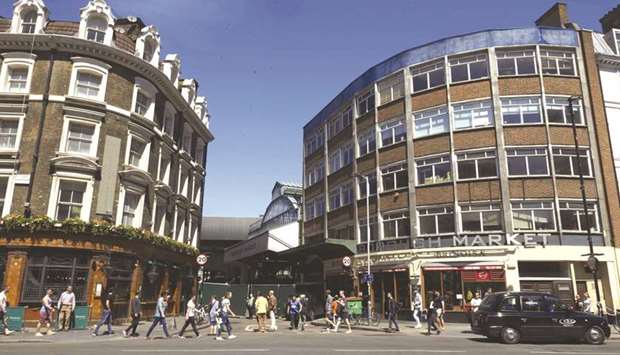
Pedestrian walk past the Southwark Tavern and Brindisa restaurant at Borough market, scenes of the London attacks as police lift the last of the cordons. The assailants behind a terror attack in London last week had also prepared a stash of Molotov cocktails.