


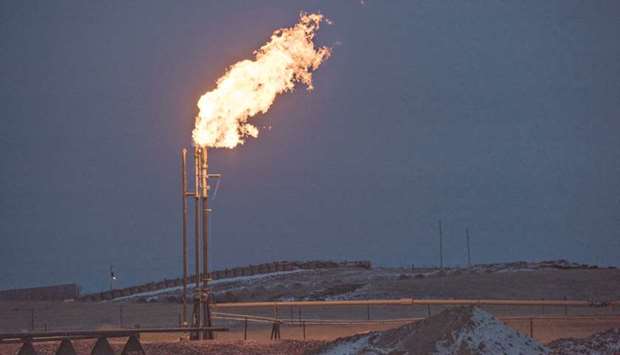
Working rigs targeting crude grew by 8 this week, bringing the total to 741, according to Baker Hughes data reported on Friday. It’s the 21st straight week of rig additions, the longest in at least three decades. The Permian Basin in West Texas and New Mexico was the only one of the four biggest US fields to grow this week, adding four, for a total of 368 oil rigs operating in the nation’s busiest region. There’s roughly a two-month lag when decisions made by explorers to change drilling activity shows up in the rig count.
“We’re still looking at a $50-a-barrel rig count,” James Williams, president of WTRG Economics in London, Arkansas, said on Friday in a phone interview. “While the costs are going up a little bit now, it’s still profitable to drill at this price.”
The rig number has more than doubled from a low of 316 in May 2016, leading a surge in American production. While the pace of US rig count increases may slow, the expansion still has some distance to run, Charles Minervino, an analyst at Susquehanna Financial Group, said on Thursday in a note to investors. “There continue to be signs of demand, despite the recent slide in crude prices,” he wrote.
Helmerich & Payne Inc, Patterson-UTI Energy Inc and Nabors Industries Ltd – the three biggest US land-drilling contractors – “are likely to see their rig counts continue to rise through the end of 2017,” Minervino said in the note. By the end of next year, the three are expected to help push the US rig count up another 200 rigs, according to Susquehanna.
Production in the US fell by 24,000 bpd to 9.32mn, according to the Energy Information Administration. It was the second drop in the past four weeks. US crude production will average more than 10mn bpd for the first time in 2018, breaking a record almost five decades old, the Department of Energy’s EIA report said.
“This might be one of the most disappointing & demoralising DoE releases of this analyst’s career – back to 1990,” Paul Sankey, senior oil and gas analyst at Wolfe Research, said earlier last week in a note to clients. “Make no bones about it, this was an unequivocally terrible set of data for Opec & oil bulls.”