


May had called the snap election confident of increasing her Conservative Party’s majority to strengthen her hand in the Brexit talks, instead, her authority has been diminished.
She now risks more opposition to her Brexit plans from inside and outside her party.
Some colleagues may be lining up to replace her, although a party source said the post was seen as too much of a poisoned chalice for the time being.
“She’s staying, for now,” the source said.
Just after noon, May was driven the short distance from Downing Street to Buckingham Palace to ask Queen Elizabeth for permission to form a government — a formality under the British system.
“As we’re the party that won the most seats and most votes we are the only party in a position to form a government,” May said.
Her office said later that the key finance, foreign, Brexit, interior and defence ministers would remain unchanged.
The centre-right, pro-Brexit Democratic Unionist Party’s 10 seats are enough to give May’s Conservatives a fragile but workable partnership, which May said would allow her to negotiate a successful exit from the EU.
“Our two parties have enjoyed a strong relationship over many years and this gives me the confidence to believe that we will be able to work together in the interests of the whole United Kingdom,” May said outside her Downing Street residence.
The DUP itself said only that it would enter talks and it was not immediately clear what its demands might be.
Since any deal is not expected to involve a formal coalition, such talks may not hold up the formation of government.
EU leaders expressed fears that May’s shock loss of her majority would delay the Brexit talks, due to begin on June 19, and so raise the risk of negotiations failing.
“Do your best to avoid a ‘no deal’ as result of ‘no negotiations’,” Donald Tusk, leader of the EU’s ruling council, wrote in a tweet.
With 649 of 650 seats declared, the Conservatives had won 318 seats.
A surprise comeback by the Labour Party gave the main opposition party 261 seats, followed by the pro-independence Scottish National Party on 34.
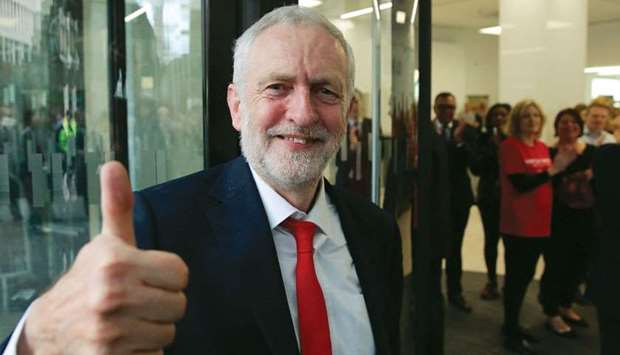
Labour’s leftwing leader Jeremy Corbyn, once written off by his opponents as a no-hoper, said May should step down and that he wanted to form a minority government.
The pound hit an eight-week low against the dollar and its lowest levels in seven months versus the euro before recovering slightly on news she would form a DUP-backed government.
The DUP, which May referred to as her “friends”, was non-committal in its initial remarks.
“The prime minister has spoken with me this morning and we will enter discussions with the Conservatives to explore how it may be possible to bring stability to our nation at this time of great challenge,” Democratic Unionist Party leader Arlene Foster told reporters.
With the complex talks on the divorce from the EU due to start in 10 days, it was unclear what their direction would now be and if the so-called “Hard Brexit” taking Britain out of a single market could still be pursued.
After winning his own seat in north London, Corbyn said May’s attempt to win a bigger mandate had backfired. “The mandate she’s got is lost Conservative seats, lost votes, lost support and lost confidence,” he said. “I would have thought that’s enough to go, actually, and make way for a government that will be truly representative of all of the people of this country.”
Corbyn would be unlikely to win backing for a minority government, but was clearly revelling in a storming performance after pundits had pronounced the Labour Party all but dead.
“We need a government that can act,” EU budget commissioner Guenther Oettinger told German broadcaster Deutschlandfunk.”With a weak negotiating partner, there’s a danger that the (Brexit) negotiations will turn out badly for both sides.”
But there was little sympathy from some other Europeans.
“Yet another own goal, after Cameron now May, will make already complex negotiations even more complicated,” tweeted Guy Verhofstadt, the former Belgian premier who is the European Parliament’s point man for the Brexit process.