


Theresa May is heading for a clear election victory, the final poll of the campaign revealed yesterday.
Ipsos MORI research — exclusively for the Standard — finds the Conservatives on 44% and Labour on 36%.
The figures point to a Conservative majority of about 40, which would be just enough for May to claim a mandate for Brexit negotiations.
But it would be short of the three-figure landslide that senior Tories hoped for when she called the snap election in April, three years ahead of schedule.
The prime minister greeted photographers with a cheery “hello” yesterday as she arrived with husband Philip to vote at Sonning girl guide and scout hut on the outskirts of Maidenhead.
For Jeremy Corbyn, the findings point to a vote share higher than the 30.4% Ed Miliband achieved in 2015 but probably a net loss of seats.
It means Labour’s bitter civil war is bound to continue, with Corbyn able to claim enough popular success to stay on as leader. Critics would accuse him of dragging the party further from power.
Corbyn smiled, waved and spoke to voters before casting his ballot at Pakeman Primary School in Holloway. “Thank you very much, all of you, for coming here,” he said to reporters. “It’s a day of our democracy. I’ve just voted. I’m very proud of our campaign. Thank you very much.”
The Liberal Democrats end their campaign on a meagre 7%, down from their 2015 election result, which will raise questions over Tim Farron’s future as leader. Sir Bob Geldof on Wednesday night called the party’s campaign “lousy” and “invisible”. The outspoken Remainer said: “I think the LibDems missed an open goal. It’s a lousy campaign. Where are they?”
Ukip is crushed to 4% and the Greens are reduced to 2%, the poll says, in a move away from the multi-party politics of recent years.
Researchers found evidence that the Tory campaign steadied in the final days of campaigning after a notable “wobble”. It raises questions about whether the London Bridge terror attack played a part in the last stages.
May’s leadership ratings fell during a campaign that was temporarily derailed by a major U-turn on the so-called dementia tax, the polling confirmed. In April, 61% saw her as the “most capable prime minister” compared with Corbyn, but that has fallen to 47%.
However, she is comfortably ahead of Corbyn, who came under relentless attack for his record on terrorism. He is preferred by 36%.
Gideon Skinner, head of political research at Ipsos MORI, said: “The Conservatives had a wobble last week, but have regained a clear lead in the last few days. May’s advantage over Corbyn is also lower than it was at the start of the campaign, but she and her party have kept their support among key voting groups such as older people. Having said that, one in five voters say they might still change their mind, so there are still votes to fight for.”
Britain ends the election deeply divided by age groups. Younger voters of 18-34 prefer Labour over the Tories by 49% to 28%. The over-65s are solidly behind the Conservatives by 60% to 23%.
A fifth of voters say they may change their mind. The Tory vote seems most firm, with only 13% uncertain, compared with 19% of Labour voters. The Liberal Democrats had the softest vote, with a third thinking they may change sides.
Some 46.9mn people are entitled to vote in 650 Westminster constituencies. Polling stations opened at 7am and closed at 10pm yesterday. A few results are expected before midnight, with the bulk flooding in overnight to give a clear outcome by the time people wake up today.
In their final campaign stops on Wednesday night, May appealed to non-Tory supporters to lend her their votes for the Brexit talks, while Corbyn told a rally in Islington that his campaign had “changed the face of British politics” and that Labour was preparing for government.
Professor Philip Cowley, of Queen Mary University of London, said it was difficult to assess the effect of the terror attacks in London on Saturday and in Manchester on May 22 on the election results.
“My suspicion is that they made almost no difference, apart from breaking the campaign up and reminding us that there are more important things in life than elections,” he said.
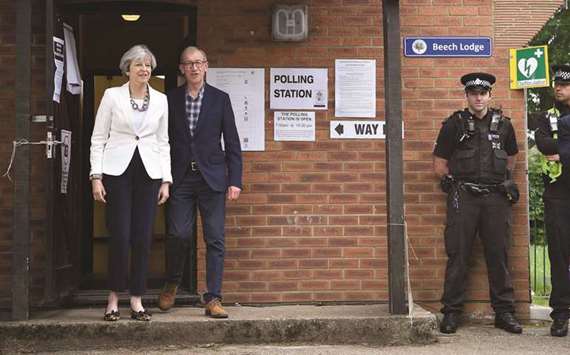
Prime Minister Theresa May and her husband Philip leave a polling station after casting their ballot paper in Sonning, west of London, yesterday.