


Andrea Zerer lifts the rifle onto her shoulder, aims, takes a deep breath and releases the safety catch. Then, pulse racing, she pulls the trigger... Bam!
She lets out a nervous laugh. Relieved and excited at the same time, she has just fired her first rifle shot. “It really does fill you with a lot of respect when you hold a weapon in your hands, feel the recoil and hear the shot,” she says afterwards.
Zerer’s instructor, Karolina Hirsch, is happy for her. At the moment, it doesn’t matter how good her aim is. That can be learned later. The main thing is that she is learning how to handle firearms at the first hunting school for women in the southern German state of Bavaria.
Learning to fire a weapon is not something most women take lightly, says Hirsch – whose name, in German, ironically means “deer” or “stag.”
She still remembers her own hunter training, and the many hours she spent practising in a shooting stand. Men would often tap her on the arm or even take the rifle out of her hands to show her how to shoot properly.
“That gets on your nerves,” says Hirsch, now 55. “And it undermines your self-confidence.” This does not make obtaining the “green diploma,” as the hunting license is dubbed in Bavaria, any easier.
Around 50,000 hunters in Bavaria possess the “green diploma,” reports Susanne Schmid of the Bavarian Hunting Association. Eleven per cent of them are women, with the numbers rising.
Women are also taking on roles in the association itself. “Since 2014 there has been a woman – me – on the committee,” Schmid says. In the sub-group Young Bavarian Hunters, the gender distribution is about 50-50.
To become a qualified hunter, trainees need to complete at least 120 hours of theoretical and practical instruction, including firing range practice.
“The number of required hours usually is inadequate,” says Thomas Licht, Hirsch’s partner. A great deal of perseverance is required, even for the clay pigeon shooting stage.
“After the 50th shot you start to get frustrated. But it’s normal – most people need 80 to 100 shots before finally hitting the target,” Licht says. And it doesn’t help if there are men are out there showing off, he adds.
Licht has always been supportive of his partner’s idea of opening a hunting school for women. In the school, Hirsch instructs students in small groups of three to eight, as well as providing one-on-one tuition, to get them ready to take the “green diploma” test.
Licht, who is also a hunter, helps out by teaching the students about the species of wildlife, protecting the environment and farming. “Men are less interested in botany, but it is actually important,” Licht says. In this area, women are more keen on learning.
It’s something the male hunters could learn from the women – as is the attitude that hunting is not primarily about killing. “We aren’t training any cowboys who only want to shoot and collect trophies,” Hirsch tells her students.
Instead, she wants to produce female hunters with a sense of responsibility, and with respect for nature. “The hunter has a duty to respect nature and to ensure the animals have a species-appropriate and healthy environment,” Licht adds.
So when it comes to botanical knowledge, the hunter should know what conditions plants need to grow, and which animals feed off them, for example.
The women hunting students come from a variety of occupations – biologist, social worker, filmmaker and butcher’s assistant, among others. Their ages range from 24 to more than 70. And not all of them plan to shoot animals – some say they simply want to learn more about the ecology of forests. None feels a desire to kill.
In hunting school, students learn how to kill an animal quickly and painlessly with a well-aimed shot. But this is only theory, Hirsch says. “If and when you actually do it is left to the individual,” she says.
She waited more than a year before making her first kill. It was a roe deer, and her pulse was racing. Killing is no fun. “But if I want to eat meat, then killing is part of it.”
If they desire, the instructor will continue to accompany the new graduates during the next stage and will give them encouragement in case their male colleagues put pressure on them because they have not yet killed an animal.
“You should not allow yourself to feel rushed,” Hirsch warns. “Killing is an intimate and serious matter and should only be done with respect for the animal.” – DPA
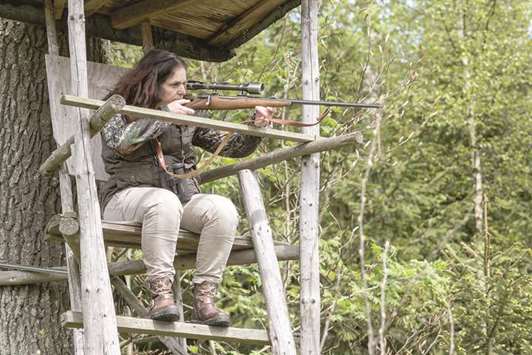
Karolina Hirsch is an instructor in Bavaria’s first school for female hunters. Students at the school learn about the ecology of forests as well as how to handle firearms.