


Mario Draghi said the euro region still isn’t generating enough inflation, overshadowing an improved outlook for economic growth that led officials to upgrade their assessment.
“The risks around the growth outlook are considered to be broadly balanced,” the European Central Bank president told reporters at a news conference after a monetary policy meeting in Tallinn. “At the same time, the economic expansion has yet to translate into stronger inflation dynamics. So far, measures of underlying inflation continue to remain subdued. Therefore, a very substantial degree of monetary accommodation is still needed.”
The change in the assessment of risks for the economy sets the scene for the ECB to start a discussion about the timing for the removal of the stimulus, though the tone of Draghi’s comments suggests officials aren’t yet ready for such a debate. That chimes with comments in the run-up to the meeting that policy makers must be extremely cautious in communicating amid a lack of convincing inflationary pressure.
“We need to be patient,” Draghi said.
“We need to continue to accompany the recovery with our monetary policy.”
Draghi said he didn’t hear any “dissenting voice” to proposals that were put forward at the meeting and that tapering of the central bank’s asset-purchase programme was not discussed at the meeting yesterday.
He said that the ECB removed its easing bias to reflect the fact that the risk of deflation has disappeared and said policy makers were becoming “more confident” that inflation will converge toward its objective in a durable way. At the same time, he stressed the central bank needs to be persistent and help the economy achieve full recovery.
The ECB cut its inflation outlook for each year through 2019 because of weaker energy costs, while raising its forecasts for economic growth. Officials now see inflation at 1.6% in 2019, down from a March projection for 1.7%. They increased their view for expansion by a 10th of a percentage point annually.
Draghi spoke on the same day that the European Union’s statistics office said the euro-area economy grew faster at the start of the year than previously estimated, driven by domestic demand. Gross domestic product in the currency bloc rose 0.6% in three months through March, revised up from 0.5%.
Earlier, the ECB changed its forward guidance on interest rates, omitting language that previously suggested officials were prepared to cut them again if needed.
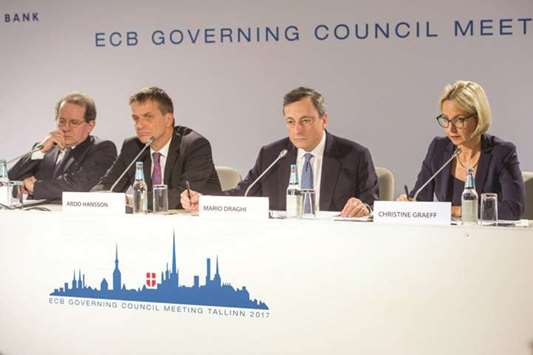
From left: ECB vice-president Vitor Constancio, the governor of Bank of Estonia Ardo Hansson, ECB president Mario Draghi and ECB spokeswoman Christine Graeff attend a press conference after the Governing Council meeting in Tallinn yesterday. Draghi said he didn’t hear any u201cdissenting voiceu201d to proposals that were put forward at the meeting and that tapering of the central bank’s asset-purchase programme was not discussed at the meeting yesterday.