


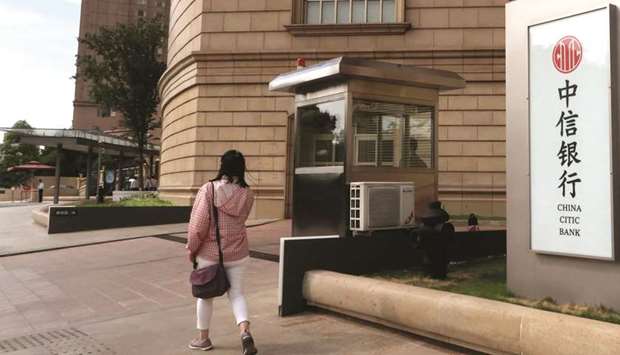
A pile of steel pledged as collateral for a loan of almost $3mn from his bank, China CITIC, had vanished from a warehouse on the outskirts of the city.
Just several months earlier, in mid-2013, Wang and the banker had visited the warehouse and verified that the steel was there. “The first time I went, I saw the steel,” recalled Wang, an attorney at Beijing DHH Law Firm, which represents the Shanghai branch of CITIC. “Afterwards, the banker got in contact with me and said, ‘The pledged assets are no longer there.’”
The trouble had begun in 2012, after CITIC loaned the money to Shanghai Hanning Iron and Steel Co Ltd, a privately held steel trader.
Hanning failed to meet payments, according to a mediation agreement reviewed by Reuters, and CITIC took ownership of the steel.
It was when CITIC moved to retrieve the collateral that the banker visited the warehouse and discovered that the 291-tonne pile of steel was no longer there, Wang said.
The bank is still in court trying to recoup its losses.
The missing collateral is a setback for CITIC. But it is indicative of a much wider problem that could endanger the health of China’s financial system – fraudulent or “ghost” collateral.
When bank auditors in China go looking, they too often find that collateral recorded on the books simply isn’t there.
In some cases, collateral that has been pledged simply doesn’t exist.
In others, it disappears as borrowers in financial distress sell the assets.
There are also instances in which the same collateral has been pledged to multiple lenders.
One lawyer said he discovered that the same pile of steel was used to secure loans from 10 different lenders.
With the mainland facing its slowest growth in over a quarter of a century, defaults are mounting as borrowers struggle to repay their loans.
The danger of fraudulent collateral in this situation, say economists, is that it exacerbates the problem of bad debt for China’s banks, increasing the risk of financial turmoil.
As growth slows, lenders can expect more nasty surprises, said Xin Qingquan, professor of accounting at Chongqing University.
More instances of fake collateral will arise, he said.
On May 24, Moody’s Investors Service downgraded China’s credit ratings for the first time in almost three decades.
The ratings agency said it expects the financial strength of the economy will erode in the coming years as economic growth slows and debt continues to rise.
The 2008 global financial crisis showed how the combination of lax lending standards and overvalued collateral can lead to disaster.
The catalyst for that meltdown was the collapse in the value of housing in the United States that served as security for a mountain of highly leveraged lending, the so-called subprime mortgages.
Now, banks in the world’s second-biggest economy face their own collateral risks. Fraudulent borrowers, corrupt bankers, poor risk assessment and a weak legal system are conspiring to load China’s financial system with loans lacking genuine collateral.
A Reuters review of dozens of court cases involving collateralised loans and interviews with lawyers, regulators and 30 bankers in China reveal that fraudulent collateral – in the form of buildings, private apartments, copper and steel – is haunting loans across a wide swath of business and industry.
The bankers interviewed by Reuters said they had encountered multiple methods by which loans were fraudulently secured, including the use of fake land certificates and bogus warehouse receipts.
Most of the bankers said that kickbacks were prevalent, with loan officers turning a blind eye to the quality of collateral and knowingly accepting dubious and even fraudulent documents.
Two of the bankers said they themselves had taken bribes to smooth the approval of loans.
Overall, 23 of the 30 bankers described the existence of ghost collateral as a serious problem and expected more instances to emerge as the Chinese economy slows.
The bankers interviewed come from 13 banks in China, including some of the nation’s biggest lenders.
There are no official statistics or estimates of the problem.
But fraudulent collateral is “a huge issue,” said Violet Ho, senior managing director and co-head of Greater China Investigations and Disputes Practice at Kroll, which conducts corporate investigations on the mainland. “Often you also see that the paperwork around collateral may be dodgy, and the bank loan officer knows, the intermediary knows, and the goods owner knows – so it’s essentially a Ponzi scheme.”
Even when banks resort to the courts, there’s no guarantee they’ll get their money back.
Inadequate legal protections for collateral and the complexity of some borrowers’ business dealings can make it difficult for lenders to foreclose.
That’s what happened to CITIC after it made the $2.71mn loan to Hanning Steel.
When Hanning defaulted, CITIC won a court order freezing the collateral, after which the parties entered into mediation, lawyer Wang Chaoyu said.
But the collateral is still missing.
In response to questions from Reuters, CITIC said that the case was still being enforced in the courts and that it had since strengthened its risk management procedures.
Representatives of Hanning did not respond to questions.
When Reuters visited Hanning’s registered Shanghai address, there was no sign of a company office there.
Total debt in China rose to 277% of GDP at the end of 2016, according to Swiss bank UBS.
That’s a record and almost twice the figure eight years ago.
Bad loans are mounting fast.
Officially, just 1.74% of commercial bank loans were classified as non-performing at the end of March.
But some analysts say lenders often mask the true level of bad debt and so the figure is likely much higher.
Fitch Ratings said in a report last September that it had estimated non-performing loans in China’s financial system could be as high as 15% to 21%.
This in a banking sector that has undergone a massive credit expansion.
The value of outstanding bank loans ballooned to $17.2tn at the end of April from $5.8tn at the end of 2009, according to data from China’s central bank.
In September last year, the Bank for International Settlements warned that excessive credit growth in China meant there was a growing risk of a banking crisis in the next three years.
In a report last September, Fitch Ratings estimated that it would cost as much as $2.1tn to clean up China’s bad debt – almost a fifth of annual Chinese economic output.
By comparison, during the global financial crisis, the direct cost of rescuing US banks was about 8% of gross domestic product.
Some economists and bankers say Beijing has the tools to avert a financial crisis.
They argue that authorities have ample financial reserves to recapitalise the banks.
And they say state ownership of lenders and of many large corporate borrowers means Beijing can head off a default or foreclosure that might spark a crisis.
But the fact that China’s banking system has been shielded by the expectation of government bailouts means lenders haven’t developed the risk assessment tools needed to judge loan exposure as banks elsewhere have.
It is this challenge of assessing the creditworthiness of borrowers that explains why physical collateral is so important for banks in China.
The China Banking Regulatory Commission, which is tasked with regulating and safeguarding the sprawling banking sector, did not respond to questions from Reuters.
Big foreign banks have not been immune to the risks of fraudulent collateral.
In a high-profile case that came to light in June 2014, banking giants including HSBC, Standard Chartered and others were exposed to potential losses totalling several billion dollars on loans to Decheng Mining, a private metals trading company in Qingdao.
The company faked warehouse receipts for the same batch of metal, using it as security for multiple loans.
A spokesman for HSBC disputed the account, saying the bank had “no material exposure of this kind,” without providing details.
Standard Chartered declined to comment on the case and Decheng Mining could not be reached for comment.
It’s not hard to dupe bankers and lawyers in a physical inspection of collateral.
Warehouses often contain hundreds of piles of steel or copper, making it difficult for an untrained observer to identify the specific pile that is serving as security for a loan their bank has issued.
“One pile of iron ore looks exactly like every other pile of iron ore, so I may say it’s mine, but it could be anyone’s,” says Kroll’s Violet Ho.
The value and quality of security in China’s real estate sector is a concern for bankers in China.
Fitch Ratings has mentioned “wildly misleading” property valuations as one reason why high collateral coverage may not protect banks.
Another is a sudden fall in property prices.
According to Fitch’s Grace Wu, over 60% of financing in China uses property as collateral in some way.
The lack of a consistent and open nationwide property registration system also increases the prevalence of fraudulent collateral.
“There is a complete lack of transparency of information,” says Ho.
The United States, she notes, has open property records that buyers can search to ascertain the true owner of a building.”You can’t do that in China.
There is no easy way to verify the information, so you have to take people’s word for it.”
Bankers say borrowers often provide them with fake cash-flow statements, so property buyers can be more leveraged than they appear.
The falsification of mortgage certificates is also a problem, they say.
That’s how the International Finance Corp (IFC), the World Bank’s investment arm, got taken for tens of millions of dollars by one of China’s richest men.
The deception began in 2007, after the IFC lent the money to Hong Kong-listed Zhejiang Glass Co Ltd, then owned by Chinese tycoon Feng Guangcheng.
Two years later, the IFC made an unpleasant discovery: In discussions with other banks it found that the collateral for the IFC loan had also been pledged to other lenders, according to a person with direct knowledge of the case.
Anxious IFC officials hurriedly dispatched lawyers to the land and company registration authorities in Zhejiang Province, where they made another startling discovery: The stamps on the mortgage certificates for the land, properties and industrial machinery used to secure the loan were fake, people familiar with the case said.