


When the ATP Race standings were updated this week Andy Murray, the world number one, languished down at 13th.
It is not a statistical anomaly either. Unlike the actual world ranking that is a rolling 12-month points total, the Race standings are a gauge of form since January when everybody starts on zero. On current form 13th is probably generous. With the French Open starting on Sunday, Murray has accrued 1,210 to the 4,915 of Rafael Nadal and looks a pale imitation of the player who won his last 24 matches of 2016 to knock Novak Djokovic off his pedestal and seize power in men’s tennis.
Not since Pete Sampras in 1999 has a world number one had a worse start to a year with Murray’s win percentage at a fairly modest 70.8% — a figure that actually disguises just how bad the slump has become of late.
There was an encouraging run to the semi-finals in Barcelona where he lost to Dominic Thiem but in Madrid, where he went down with a whimper against Borna Coric, and in Rome where he was defending champion he was outclassed by Fabio Fognini.
Last year, when Murray won nine titles including a second Wimbledon, a second Olympic title and the ATP Tour Finals in London, he suffered nine losses all season. This time his win-loss record reads 16-7 and it’s only May. Murray seems muddled and at a loss to explain his struggles. But with a huge haul of ranking points to defend in the next couple of months, starting at Roland Garros where he lost to Djokovic in last year’s final after his best claycourt season, he needs a solution fast.
“There is no reason for it from my end,” Murray said. “I’m just not playing good tennis and I need to try and work out how to turn that around. Last couple of weeks have been a struggle and a long way from where I’d like to be.”
It is the nature of the defeats that is most surprising.
At the start of the European claycourt swing in Monte Carlo Murray lost to Spaniard Albert Ramos-Vinolas having led 4-0 in the final set. In Madrid he was bullied by the 20-year-old Coric and in Rome he was flattered by the 6-2 6-4 scoreline against an inspired Fognini. Earlier in his career Murray was criticised for being too passive with his game — a preference for playing counter-attacking tennis based on rock-solid defence and superhuman court coverage rather than taking it on.
With the help of coach Ivan Lendl, he became more forceful, leading to breakthrough titles at the 2012 US Open and Wimbledon in 2013 and Lendl’s second stint as coach spurred Murray to become world number one.
However, he seems to have slipped back into lock-down mode and has paid the price especially against aggressive opponents who enjoy playing on the front foot such as Thiem and Fognini. A closer look at the data offers some clues on Murray’s woes. Last year he won 85% of his service games compared to 79% this year.
In 2016 he won 54 % of points on second serve — an area of weakness he worked tirelessly to make more of a weapon. That vulnerability seems to have returned as in his last two defeats he managed to win 37 and 35% respectively.
And his forehand, another shot that became far more potent under Lendl, seems to have lost some fizz.
Murray insists the number one ranking has not weighed him down and the fact that he has reached 30 should not be significant — as these days 30 appears to be the new 20.
The bout of shingles he suffered after the Australian Open and elbow problem that flared up during a first-round defeat to Vasek Pospisil at Indian Wells have been contributory factors while there are suggestions his pre-season training block left him jaded for the battles ahead.
It could all turn round at Roland Garros, where Lendl will be a reassuring presence back in his box after leaving match-day coaching duties to Jamie Delgado for most of this year. But with vulnerability having replaced the sense of invincibility Murray worked so hard to build, the vultures will be circling above him on the red Parisian clay.
Zverev shrugs off German expectations at French Open
It’s been 80 years since a German man won Roland Garros but despite his stunning demolition of Novak Djokovic in Rome, Alexander Zverev insists he is not the French Open champion in waiting. The 20-year-old Zverev heads for Paris viewed as the man most likely to profit should nine-time champion Rafael Nadal, world number one Andy Murray and 2016 winner Djokovic falter.
“You know, when I was about 11, 12, I thought by the age of 20 I’d probably win about four Slams already,” joked the beanpole German keen to keep a lid on growing expectations that the sport’s much-touted ‘Next Gen’ is about to gatecrash the Grand Slam closed shop.
There’s little doubt that 20-year-old Zverev is the real deal. He boasts an address amongst the high-rollers of Monte Carlo, while flitting between Hamburg and Florida.
Three titles have already come his way in 2017 — indoors at Montpellier and crucially, in terms of Roland Garros, on clay at Munich and in Rome on Sunday.
There he stunned Djokovic in straight sets, becoming the youngest champion in the Italian capital since a 19-year-old Nadal in 2006.
He was also the youngest Masters winner since Djokovic, at 19, captured Miami a decade ago.
Furthermore, he was the first player born in the 1990s to win a Masters crown and only the fourth German after Boris Becker, Michael Stich and Tommy Haas.
The legacy of Becker, the last German man to win a Slam of any description at the 1996 Australian Open — a year before Zverev was even born — stalks the young pretender, like so many of his compatriots in the last two decades.
But he has already achieved what Becker, a six-time major champion and winner of 49 career titles, failed to do — win a clay court tournament.
At Roland Garros, Becker never made it past the semi-finals. Zverev, now at a career high of 10 in the world following his Rome triumph, will be playing in his third Roland Garros.
He made the third round last year while, in 2013, he was runner-up in the junior final.
But he has no doubt that the rejuvenated Nadal, bidding for a 10th French Open, remains the overwhelming favourite for the 2017 title.
“Strong favourite,” he added for emphasis.
“I think Novak is playing quite great again. Dominic (Thiem, who beat Nadal in Rome) has been showing he’s been playing very, very well.
“I’ve got to put me on that list even though, you know, I don’t want to sound like I want to say that I’m the favourite myself or something like this.
“But, you know, those kind of guys who have been playing the best over the last few weeks are definitely the favourites.”
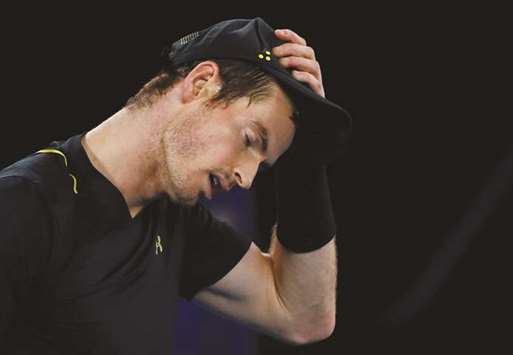
Britain’s Andy Murray reacts during his singles second round match against Russia’s Andrey Rublev at the Australian Open in Melbourne on January 18, 2017. (Reuters)