


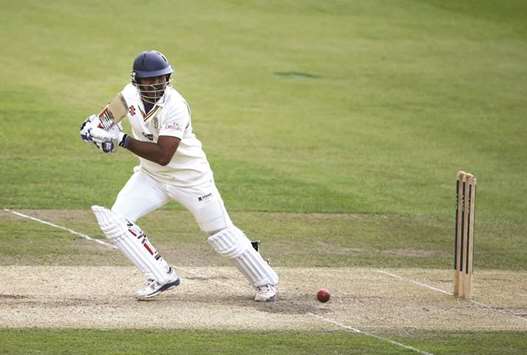
“You try to fight the inevitable but you need to get out while you’re ahead,” the 39-year-old told the BBC on Monday. “It’s the last time I’ll play a four-day game here. I’ll be 40 in a few months, this is about the end of my time in county cricket.”
As well as his Test exploits, Sangakkara has been one of the game’s great limited overs batsmen and was part of the Sri Lanka team that reached the 2007 and 2011 World Cup finals, although they lost to Australia and India respectively. His Twenty20 commitments will take him through to 2018, but his time in the longer format is almost over. “My career might have a few more months (left) but that’s about it,” he added. Having joined Surrey for the 2015 season, Sangakkara is still in good form. He scored over 1,000 first-class runs last term and hit two centuries against Middlesex at the weekend but felt it was still time to walk away.
“The biggest mistake that sometimes you can make is that you think you’re better than you really are,” he said. “Cricketers, or any sort of sportsperson, have an expiry date and you need to walk away. I have been very lucky to play for as long as I did so but there’s a lot more life to be lived away from the game.”
Anderson suffers groin injury ahead of England’s Test summer
England pace spearhead James Anderson faces a battle to be fit for the opening Test against South Africa in July after scans confirmed he had suffered a tear to his right groin when playing for Lancashire in the county championship.
Anderson, England’s leading test wicket-taker, limped off midway through his sixth over on Friday against Yorkshire at Old Trafford and did not bowl again in the match. The 34-year-old will miss Lancashire’s return fixture against Yorkshire starting June 2 as he will be assessed by England’s medical team to understand the extend of the injury.
Anderson, who missed four of England’s last 10 Tests with a shoulder injury last year, could still feature in three county matches in June to prove his fitness ahead of the international season. England host South Africa in first of four Tests starting on July 6 at Lord’s before welcoming West Indies in a three-match series to wrap up the Test summer in August and September.
Australia board gambled on players’ greed and lost: Chappell
Australia’s cricket board gambled that greed would motivate top players into accepting a pay offer and while that bet has backfired the parties are likely to thrash out a deal in time to avert an Ashes boycott, former captain Ian Chappell has said.
Players have rejected Cricket Australia’s (CA) offer that would end a 20-year-old revenue-sharing model when the next collective bargaining agreement starts in July. The proposal offers more money than the current five-year CBA but allows only international players to share in surplus revenues, while domestic cricketers would have to settle for fixed amounts. Former Test skipper Chappell was a leading figure in Australian cricket’s most bitter pay dispute in the 1970s, which paved the way for the breakaway World Series Cricket. “I’m delighted the players are sticking together and staying strong on it,” Chappell said in comments published by Sydney newspaper the Daily Telegraph.
“From afar it looks as though the board are trying to splinter the players, which I find a rather strange tactic. Maybe the board thought, ‘You know what the players are like’. They were working on the theory of greed, that you keep the top blokes happy with money and they won’t care about the rest. It looks like they’ve picked the wrong target.”
CA CEO James Sutherland raised tensions earlier this month when he told players to agree to terms by the June 30 deadline or risk being unemployed.
It elicited a heated response from the Australian Cricketers’ Association, the players’ union, and opening batsman David Warner warned the board it might not have a team for the five-Test Ashes series starting in November. CA have declined to comment further on the pay dispute.
Chappell said Australia’s top players could easily play as free agents in the world’s lucrative domestic Twenty20 competitions. But he doubted it would come to that. “There will be more posturing and eventually they’ll come to their senses,” he said.