


The recent selloff in emerging Asian bonds isn’t enough to shake the conviction some fund managers have in the region’s high-yielding debt.
Standard Life Investments, Western Asset Management Co and PineBridge Investments, which oversee more than $800bn in assets between them, are seeing opportunities for more gains from high yields and growth prospects in India and Indonesia. That view contrasts with a rising rhetoric on the risks developing markets face from political turmoil in the US and Brazil, a slump in commodities, China’s clampdown on leverage and higher US interest rates.
“We are still quite sanguine on the Asian local-currency space,” said Desmond Soon, head of investment management for Asia at Western Asset, which oversees $433bn. “Asia continues to offer steady political dynamics and strong fundamentals. India and Indonesia have been our preferred overweights.”
The Bloomberg Emerging Market Local Sovereign Asia Index has extended declines this month after falling in April amid concern China’s efforts to contain its credit boom may have repercussions for the region’s growth, and as US President Donald Trump warned of a “major conflict” with North Korea. While rupiah and rupee bonds haven’t gone completely unscathed, their returns over a three-month period have been the best in the region, indexes compiled by Bloomberg show.
Columbia Threadneedle Investment and Union Bancaire Privee Ubp are calling time on gains in some developing currencies, with the former flagging risks from higher US rates, a stronger dollar and weaker commodities, and the latter citing China’s deleveraging policy. Emerging markets are complacent over risks from China, according to a Goldman Sachs Asset Management note this month.
That said, the argument in favour of high-yielders got a boost on Friday, when S&P Global Ratings raised Indonesia’s credit rating to investment grade. The S&P upgrade will boost appetite for Indonesian bonds and the authorities hope the nation’s credit rating outlook will soon be revised to positive, Finance Minister Sri Mulyani Indrawati said on Friday.
“Risk repricing is not the demise of emerging-market bonds at all,” said Vishnu Varathan, a senior economist at Mizuho Bank Ltd in Singapore. “High yielders remain an opportunistic bet in a low yielding environment. With lower Fed neutral rates and improving growth in the region, demand for yields will be an enduring theme, although price is the variable.”
India has seen inflows accelerate after Prime Minister Narendra Modi’s party won in key state elections in March, spurring expectations of more policy changes to boost one of the world’s fastest-growing major economies. Slowing inflation and a strengthening currency have burnished the appeal of assets in the nation, which is on the cusp of a sweeping tax overhaul.
S&P’s upgrade of Indonesia could pave the way for more fund flows, with Goldman Sachs Group forecasting in March that as much as $5bn may flow in from Japan in such an event. President Joko Widodo has been making strides in overhauling the tax system, accelerating infrastructure spending and cutting red tape to woo businesses.
“In the absence of external shocks, we expect the Indian rupee and Indonesian rupiah to remain well supported given the robust balance of payments dynamics evident in both countries,” said Mark Baker, Hong Kong-based investment director for emerging-markets fixed income at Standard Life, which oversaw the equivalent of $358bn globally at the end of 2016. “Sustained progress with major reforms would underpin demand for assets which would be supportive of duration gains in fixed income.”
While there are some concerns over valuations, bonds in India and Indonesia continue to attract global funds. Foreign holdings of rupee-denominated government and corporate debt have surged by Rs768bn ($11.9bn) so far in 2017, after falling Rs306bn last year. Rupiah notes have lured $6.32bn.
“It’s no secret that foreign investors think that Asia is expensive compared to other emerging-market peers, but that’s for a good reason,” said Soon of Western Asset. “One look at overall credit ratings and aggregate foreign-exchange reserves drives home the point that the region as a whole has emphasised quality to instil confidence and developed measures to address external shocks.”
At 6.99% for Indonesia and 6.71% for India, the yields offered by benchmark 10-year bonds in the two nations are the highest among major Asian markets.
“India and Indonesia remain at the forefront of the Asia high-yield local market trade,” said Anders Faergemann, senior fund manager in London at PineBridge, which oversees about $80bn globally. “They may continue to benefit from a generally optimistic investor outlook unhindered by today’s risk-off sentiment, stemming from increased political risk in Brazil.”
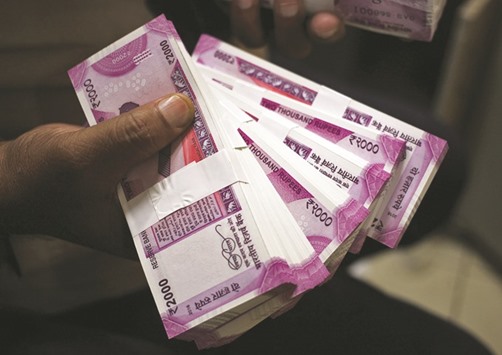
A cashier displays Indian rupee banknotes inside a bank in Jammu. Foreign holdings of rupee-denominated government and corporate debt have surged by Rs768bn so far in 2017, after falling Rs306bn last year.