


A new report shows that the Islamic financial services industry is on a consequent growth path despite changing policies in the global financial markets and an uncertain economic environment. According to the IFSI Stability Report 2017 released by Kuala Lumpur-based Islamic Financial Services Board (IIFS), an international standard-setting body in the Islamic finance industry, the sector has gained market share in the last year, particularly in its core markets. However, the report also found that global double-digit percentage growth rates of the past have now slowed down to single-digit growth.
The annual report is focusing on three main segments of the Islamic financial services industry, namely banking, capital markets and the takaful sector. It provides an in-depth analysis of the performance and stability of the industry in 2016 and looks at the interrelation to macroeconomic factors such as interest rates, unemployment, real estate prices and oil prices in the various jurisdictions.
In the Islamic banking sector, the report found a more dynamic development contradictory to just moderate growth rates in total banking assets, underpinned by “reasonable levels” of growth in assets, financing and deposits of Islamic banks in most markets. In detail, the market shares of Islamic banks increased in 18 jurisdictions, indicating a growing acceptance of Islamic finance in markets with both Islamic and conventional financial systems. In 12 of these jurisdictions, Islamic finance has achieved domestic systemic importance, the report notes.
On average, the Islamic banking sector saw stable return on assets and on equity over the past two years, but some countries struggled with declines and a decrease in asset quality, including a higher share of non-performing loans, according to the report. The capitalisation in the industry at Tier-1 level was 9.71% in the first half of 2016, which is above the Basel III minimum regulatory requirements of 6%.
That said, short-term liquidity remains a concern for Islamic banks since by investing in long-term assets they are faced with the problem that most of their deposit liabilities are very short-term, leading to partly serious liquidity problems. For example, although sukuk can be traded, most are held to maturity and liquidity remains very low. Remedy could be provided by the creation of liquidity management tools that are both flexible and Shariah-compliant. But the lack of such tools is often seen as a major constraint to the development of an integrated Islamic financial system, with Malaysia being a notable exception.
In terms of sukuk, 2016 saw an increase in issuances. The total volume of sukuk issuances reached $75bn in 2016, bringing the total volume of outstanding sukuk close to $350bn, with 79% of the issuances originating from sovereigns, government-related enterprises and multilateral organisations, and 21% issued by Corp issuances.
Islamic stocks continued to generate profits in 2016, albeit and in contrast to previous years, they generated lower returns in comparison to conventional equities. This is owing to macroeconomic reasons during most of 2016 such as political uncertainties, slow growth, continued low oil prices and volatile commodity prices. However, towards the end of the year, both Islamic equity and fixed income funds showed better performance as the US election outcome triggered a stock market rally while oil prices also increased.
Looking at the takaful sector, the report found that the global Islamic insurance industry recorded a growth in contributions of 12% as compared to 4% in the conventional insurance market. Anyway, takaful and retakaful remain a small industry with a total annual contribution volume of $25bn and a relatively low penetration in most Islamic countries.
In its outlook, the report takes a generally positive stance, although fiscal deficits in most core markets as a result of low oil prices could continue to suppress government spending, which, in turn, would have an adverse effect on Islamic banks. In a period of weak economic growth and global uncertainties, the Islamic financial services industry keeps facing the challenge of building long-term resilience in such an environment, the report concludes.
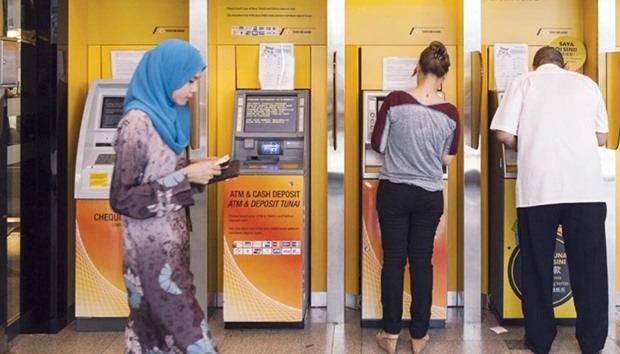
Customers use ATMs at a combined Malayan Banking Bhd (Maybank) and Maybank Islamic Bhd bank branch in Kuala Lumpur. The market shares of Islamic banks increased in 18 jurisdictions, indicating a growing acceptance of Islamic finance in markets with both Islamic and conventional financial systems, according to the IFSI Stability Report 2017.