


Hawkish tones from the US Federal Reserve, easing commodity prices and lacklustre Chinese data weighed on emerging market assets yesterday with stocks extending losses for a second day and currencies weakening.
MSCI’s emerging market index fell 0.3% as bourses in much of Asia and Turkey lost ground.
Stocks in China closed at a three-month low after a survey showed activity in services sector grew at its slowest in almost a year in April, raising concerns over economic risks.
The losses came after the Fed kept its benchmark interest rate steady as expected on Wednesday though downplayed weak first-quarter economic growth, emphasising labour market strength and signalling it was still on track for two more rate rises this year.
Yet investors expected this to be a temporary soft patch for many emerging assets, with markets closely watching key US employment data out today to show solid increases. “US dollar and US Treasury yields (are) up post-FOMC but not convincingly so with futures almost ‘fully’ pricing in a June hike, leaving emerging market assets in a benign space of their own,” said Simon Quijano-Evans, emerging market strategist at Legal & General Investment Management.
Russian stocks bounced back from the previous days heavy losses when shares in Sistema collapsed after oil major Rosneft filed a $1.9bn lawsuit against the business conglomerate.
Sistema shares gained nearly 10% yesterday.
South Korean stocks hit a record high on robust exports, upbeat earnings and rising hopes for economic stimulus as the presidential election approaches.
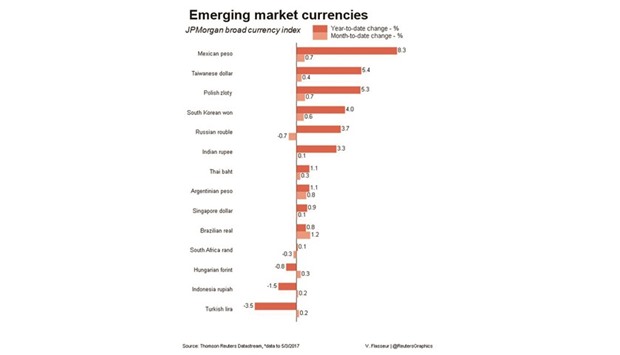
However, the dollar extending the previous session’s gains, crude oil prices trading near their weakest since late March and copper teetering near a four-month low weighed on currencies.
South Africa’s rand fell 0.6% to its weakest in three weeks as data showed private sector activity contracted for the first time in nine months in April as new export orders continued to decline and growth remained marginal in Africa’s most industrialised economy.
Russia’s rouble nearly matched those falls, weakening for a fourth straight session, while Turkey’s lira slipped 0.2%.
In the Czech Republic, central bank policymakers were expected keep interest rates unchanged until 2018 as they concluded their first meeting since they lifted the cap on the Czech crown. “While no one expects the Bank to hike rates, the focus will be on the CNB’s thinking on real economy developments, strength in the labour market in particular, and the fact that the exit from the FX regime has so far not resulted in a pronounced crown appreciation,” Nomura’s Henrik Gullberg wrote in a note to clients.
A Reuters poll showed that analysts expected the Czech crown to gain more than 4% against the euro in the coming year, lifted by economic growth and anticipated monetary tightening while shrugging off political uncertainty.
Venezuela’s dollar-denominated bonds came under pressure as protests against the government escalated further.
Security forces battled protesters who lit fires and hurled stones on Wednesday in rage at President Nicolas Maduro’s decree to create an alternative congress, with another fatality taking the death toll to 34 during a month of unrest.
.