


If you place your faith in opinion polls, two things are clear about the French presidential election.
The first is that it’s impossible to say which two candidates will make it through Sunday’s first round of voting.
Far-right leader Marine Le Pen and centrist reformer Emmanuel Macron are neck and neck.
Close behind them are conservative Francois Fillon, still suffering from the scandal over his wife’s allegedly fake job as his parliamentary aide, and firebrand leftist Jean-Luc Melenchon.
The second conclusion from all the polls published so far is that National Front leader Le Pen, assuming she makes it through Sunday’s vote, is very unlikely to be elected president.
The polls show her losing to any of the other three in a second-round contest.
Macron, meanwhile, would beat any opponent in the second round.
That should be reassuring for those worried by the National Front’s far-right, anti-immigrant history or by Le Pen’s determination to pull out of the euro currency — and effectively remake or leave the EU.
But the last year has seen right-wing, isolationist positions win out twice against the predictions of pollsters: with Donald Trump’s election as US president, and Britain’s vote to leave the EU.
Could France be in for a similar surprise?
One analyst who thinks so is Serge Galam, a physicist turned political researcher at France’s Science Politiques Centre for Political Research.
He recently told newspaper Le Figaro that a Le Pen victory was now “very possible.”
Even if the polls are right about the relative levels of support for Le Pen and any second-round challenger, he argued, a higher turnout among her voters could swing the election for the far-right leader.
Edouard Lecerf, global director of political and opinion research at the Kantar Public polling firm, is a bit more sceptical.
The good thing about the Trump and Brexit results, he remarks, is that “now we’re not the only ones to say: ‘Be careful, it’s just a poll.’”
A poll is not a prediction, he is at pains to point out, and with an increasingly shifting electorate, “the shelf life of a poll, its use-by date, has got much shorter.”
Three key factors make this election particularly hard to call, Lecerf says: the presence of four realistic first-round candidates, the high level of voters considering abstaining, and high levels of uncertainty among supporters of Macron and the left-wing candidates.
As for Galam’s scenario for a Le Pen victory, he considers it “possible but very very unlikely.”
He notes that probably no more than 9mn voters have ever cast a ballot for the National Front, out of an electorate of 47mn.
Lecerf sees another hypothesis, more likely but still “not really probable,” for a possible Le Pen victory.
If the National Front leader does better than expected in the first round and Fillon is knocked out, she could create a “political blast effect,” he says.
“She could find voters who didn’t vote in the first round, weaken the idea that her election is a real danger, that it’s unrealistic...that leaving the euro is madness, etcetera, and manage to convince some of Fillon’s voters to choose her. But all those things really have to come together.”
The likely Le Pen tactic in the second round would be to try and re-centre the debate, not on left-right lines but around “Europe and the system,” Lecerf predicts.
In that case her possible voter base could be not the estimated 9mn previous National Front voters, but the more than 15mn who voted against a draft European constitution in 2005.
Such a campaign could pit those in favour of “a Europe that’s still our future, a globalisation that brings benefits” against those both on the right and on the left who feel the need to protect themselves through “a closing off of France, whether social, cultural or economic,” he says.
It is a scenario similar to Trump’s election and the Brexit vote, and the only way for Le Pen to break the “glass ceiling” that has hampered the National Front’s progress to date, Lecerf says.
But, he adds, if Le Pen faces off against Macron in the second round, the young former economy minister also has a powerful weapon in his more optimistic approach.
He is “playing on the idea that we can still be optimistic,” Lecerf explains.
“In France, presidential campaigns are an astonishing moment where people typically want to regain hope.Every single time.”
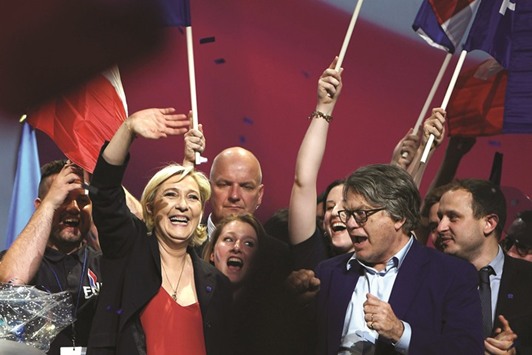
French presidential election candidate for the far-right Front National (FN) party Marine Le Pen reacts as she is flanked by FN party member of parliament Gilbert Collard (right) at the end of a campaign meeting on April 19, in Marseille, southern France.