


Far-right presidential frontrunner Marine Le Pen said yesterday that French people felt “dispossessed” in their own country as she stressed the threats of immigration and terrorism in the final days of campaigning.
The 48-year-old former lawyer has spent years trying to broaden support for her National Front (FN) party, but she has signalled a return to the core concerns of many of her supporters in recent speeches.
Speaking on BFM television yesterday, Le Pen emphasised how she would pull France out of the European Union, slash immigration, make it harder to get French nationality and crack down on suspected Islamists.
“French people have the feeling of being dispossessed of their identity, of their social security system and their sovereignty,” Le Pen told the channel.
Polls show a four-way race developing ahead of the first round of the election on Sunday between Le Pen, 39-year-old centrist Emmanuel Macron, conservative Francois Fillon and far-left firebrand Jean-Luc Melenchon.
A new survey published yesterday showed Macron leading on 23%, Le Pen on 22.5%, Fillon on 19.5% and Melenchon on 19%, but the gap between all of them is closing. The top two will advance to a run-off vote on May 7.
Jean-Yves Camus, an academic and expert on the FN, told AFP that Le Pen had returned to the “fundamentals, and particularly immigration” in the final run-in.
“It’s back to basics. We also heard the old slogan ‘France for the French’ at the meeting (on Monday night),” he said. “The FN top brass has decided to go full throttle for far-right voters.”
After a string of Islamist-inspired assaults in France, security concerns moved to the centre of the campaign Tuesday following the arrests of two French men suspected of preparing an attack to disrupt the election.
The two suspects, who were detained in Marseille with a cache of weapons and explosives, were being questioned in the southern city yesterday where Le Pen is set to appear later at a rally.
Le Pen has claimed that her proposals such as expelling any foreigner convicted of a crime or suspected of being radicalised would have helped prevent some of the attacks since 2015 which have claimed more than 200 lives.
Left-leaning Le Monde newspaper said her claim was “absurd” given that most of the attackers were French, many without criminal records.
“You don’t seek votes on the backs of dead people. It’s a sort of moral red line,” the newspaper said.
French voters have so far been more concerned about unemployment and their spending power than terrorism or security, polls show, though analysts warn this would change quickly in the event of bloodshed.
Some analysts have also depicted the French election as a sort of referendum on the European Union, with Le Pen proposing to pull France out of the 28-member club and scrap the euro common currency.
On Tuesday night, she insisted that the TF1 television channel remove the blue-and-yellow European flag from behind her before an interview.
But Melenchon, her eurosceptic far-left opponent, sought to soften his position on Tuesday night, stating that he did not seek to end the European Union or the euro despite criticising the “ultra-liberal” trading bloc for years.
“Don’t believe what they tell you, ‘He wants to leave Europe, the euro’...let’s be serious,” he told supporters.
The Communist-backed candidate has pledged to renegotiate some of the founding treaties of the bloc, however, which would cast serious doubt on the viability of the postwar project of integrating the continent.
Polls show that a majority of French people still support the EU and the euro. Veteran centrist Francois Bayrou, who has backed Macron, warned yesterday that several possibilities were possible for the run-off vote on May 7.
The election has been one of the most unpredictable in decades and takes place against the backdrop of Britain’s shock decision to leave the EU and Donald Trump’s presidential victory in the United States.
“A second round Melenchon-Le Pen, it’s terrifying for the country, for the image of the country and for its future, because the choices proposed are extremely risky,” Bayrou said.
One-time frontrunner Francois Fillon, a conservative ex-prime minister from the Republicans party, got a boost from popular party heavyweight Alain Juppe who agreed to appear with him in public in Paris.
Juppe has avoided Fillon since January when a scandal broke about the candidate’s wife being paid hundreds of thousands of euros for an allegedly fake parliamentary job.
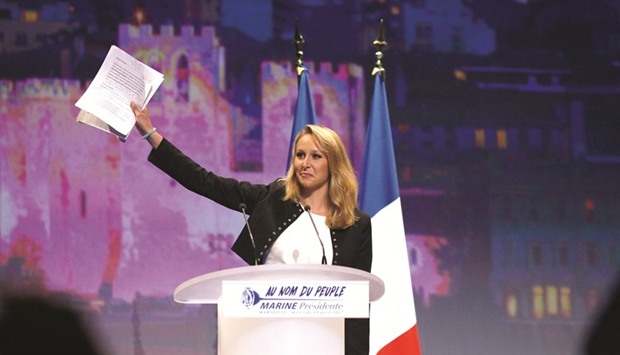
Marion Marechal-Le Pen, French National Front political party deputy, attends a political rally as she campaigns for Marine Le Pen.