


Frauke Petry, co-leader of the Alternative for Germany (AfD), said yesterday she would not lead the anti-immigration party’s campaign for a September 24 federal election — a shock announcement from the woman seen as the face of the party.
Opinion polls show the AfD winning enough votes to enter the Bundestag lower house of parliament for the first time.
But the AfD has lost about a third of its supporters as migrant arrivals to Germany have eased and the party has also been hit by infighting and controversy over its attitude to the Nazi past.
Petry caused controversy by tabling a motion for a party congress next weekend in which she said the AfD — which is shunned by other parties — should be ready to join coalitions in future. She also said some senior AfD members such as Alexander Gauland wanted it to be a “fundamental” opposition party.
Speaking in a video message posted on her Facebook page, Petry said she had been accused of making the proposal solely to become the party’s top candidate despite her not mentioning that idea in her motion.
“In order to put an end to all speculation in this regard, I am using the opportunity of this video message to clearly state that I am neither available for a lone lead candidacy nor for participation in a top team,” she said.
The AfD, which rails against Chancellor Angela Merkel’s decision to allow more than a million migrants into Germany since mid-2015, is due to decide on its election leadership line-up at its weekend gathering in the western city of Cologne.
Petry’s camp wants to expel from the party a senior member, Bjoern Hoecke, for calling Berlin’s Holocaust Memorial a “monument of shame” and saying history books should be re-written to focus more on German victims of the Nazis.
Petry, a 41-year-old chemist from the former Communist East Germany, managed to secure a two-thirds majority on the party executive board in favour of expelling Hoecke.
The far-right wing of the AfD supports him, however, and a party arbitration board must now decide his fate.
A Forsa opinion poll published yesterday showed the AfD winning 8% in the election, well above the 5% threshold needed to win seats in the Bundestag.
Germany’s Der Spiegel magazine has reported that Petry’s opponents agreed at a secret meeting last week to form a team around 76-year-old publicist Gauland and 38-year-old economist Alice Weidel — who, like Petry, wants Hoecke ousted.
The AfD could not be reached for comment on the report.
German Chancellor Angela Merkel’s conservative political bloc has maintained a solid lead in opinion polls published yesterday — less than six months before voters in Europe’s biggest economy go to the polls.
The centre-left Social Democrats (SPD) had enjoyed a surge in support in opinion polls in January after the party selected former European Parliament President Martin Schulz to topple Merkel in the national election set down for September.
But voter surveys from the INSA and Forsa polling groups pointed to the so-called Schulz effect as having faded just as the SPD enters the critical stage of its campaigns for elections next month, one in the small northern state of Schleswig-Holstein, the other in North Rhine Westphalia, Germany’s most populous state.
The survey from Berlin-based pollsters Forsa showed Merkel’s Christian Democrats (CDU) and their Bavarian-based Christian Social Union (CSU) allies unchanged at 36% of the vote with the SPD stuck at 30%.
The INSA poll published in the daily Bild recorded a similar result with the CDU-CSU rising one percentage point to 34% as the SPD dropped back to 30.5%.
If voters could directly elect the chancellor 44% of voters would have backed Merkel, while support for Schulz as chancellor has slumped 3 percentage points to 31%, according to Forsa.
Both polls also point to the CDU-CSU along with five parties gaining seats in the national parliament, the Bundestag, after the September election, including the pro-business Free Democrats, the environmentalist Greens and the hard-left Die Linke.
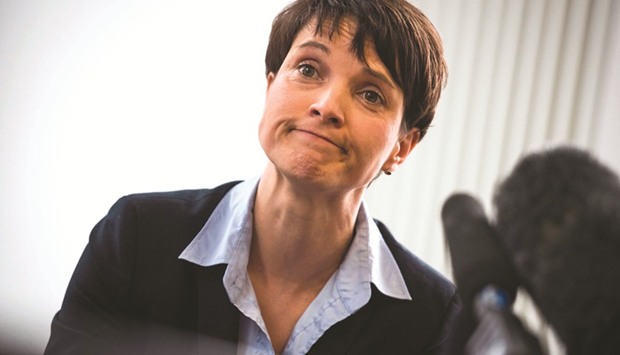
Frauke Petry