


For all the hurdles faced by Indian lenders, there are bank bonds out there that investors can’t get enough of.
State Bank of India’s perpetual notes – so called because they lack a fixed maturity date – are being hoarded and hunted by traders betting the nation’s biggest lender will buy them back within the next 10 weeks as it puts its capital structure in line with Basel regulations.
That’s created a trading opportunity for investors like Carl Wong of Nexus Investment Advisors and Raj Kothari of Jay Capital, who say SBI’s perpetual bonds are the only notes that have yet to be redeemed as part of the revamp.
Lenders around the world have been scrabbling to redeem bonds issued before the financial crisis that will lose their status as contributors to core, Tier-1 capital as the Basel III norms come into effect. But Indian banks have an extra incentive to call the debt: they’re flush with cash after households poured money into deposits following the government’s decision in November to pull high-value banknotes from circulation to combat tax evasion and graft.
“This is a very low-beta, low-risk, high-return trade,” Wong said in a London interview. “If I can put more money into it, I would. At yields of about 6%, they can be a good shock absorber in a portfolio as global rates go up.”
SBI’s $400mn bond, which pays a coupon of 6.439%, traded at a bid yield to next call of 6.21% yesterday. Its call date falls on May 15.
The lender’s $225mn bond, which pays a coupon of 7.14%, traded at 7.25% and has its call date on June 27.
If they aren’t bought back, the notes will no longer count toward meeting capital-adequacy ratios and must be relegated to senior debt under the new banking regulations.
“It’s not easy to source these papers in size,” Wong said. “However, if you are patient enough, you can buy in clips.”
While SBI declined to comment on whether it would call back the bonds, it denied that India’s cash ban might play a role in the decision.
“We would not comment on market speculation,” Ritesh Mehta, assistant vice president for corporate communication at the lender, said by email.
The bonds “were issued in US dollars and the funds were utilised in the overseas market. Hence, demonetisation has no relevance in this matter,” he said.
Investors who own the bonds say the banknote ban boosts the chances of a buyback. “There is a high chance that the bonds will be called back because Indian banks are flooded with cash,” said Kothari, head of trading at Jay Capital in London. “These lenders can refinance at lower rates and retire a debt that doesn’t even qualify as capital any longer.”
Indian banks may have the worst bad-asset ratio globally, but with an economy growing at a pace of 7% in the fourth quarter, that isn’t enough to put investors off the debt, according to Wong.
“The average non-performing loans are quite severe,” he said. “The good thing is they are transparent.
As long as the growth is in place, it will help banks to eventually resolve this problem.”
While the high coupon and the loss of capital status are supportive of a buyback, there’s no guarantee banks will choose the option. In Europe, investors took a hit when Standard Chartered and Commerzbank decided not to call back their legacy notes in November.
Still, bondholders are relying on the market convention that banks typically redeem such notes in order to maintain a good relationship with investors. Other Indian banks including ICICI Bank have already called theirs.
“It hampers reputation if they don’t exercise the option,” Kothari said.
Earnings at risk if rupee extends rally: Edelweiss
Bloomberg/Mumbai
India stock bulls, beware. A stronger currency could spoil the party. A further advance in the rupee to 62 per dollar in the year to March 2018 could shave four% off the NSE Nifty 50 Index’s earnings growth, according to Edelweiss Securities.
Nifty companies are vulnerable to foreign-currency swings because nearly half the index’s profits are linked to the global economy through exports, overseas subsidiaries and commodity prices, the brokerage said in note on April 17. Earnings per share of the Nifty members may grow an average 28% this fiscal year, according to analysts’ forecasts compiled by Bloomberg.
Gains in the rupee, Asia’s best performer in the past three months, have underpinned a rally that sent Indian equities to all-time highs this month. The correlation between the two asset classes has “probably played out,” Mumbai-based Edelweiss said. The Nifty has climbed 12% since January 1. The rupee has risen 5.2% against the dollar to 64.5, surpassing the broker’s forecast of 67.
Still, the correlation between the two asset classes may be as strong as it was over 2006-2008, when the rupee rallied 11%, the brokerage said. This time around, they may not move “as dramatically” as the currency’s outperformance versus emerging-market peers has come amid modest global growth, according to the report.
The rupee’s gain between January and March was the most for any first quarter since 1975, as foreigners bought over $12bn of stocks and bonds after a resounding win for Prime Minister Narendra Modi’s party in key state polls boosted bets for more economic reforms.
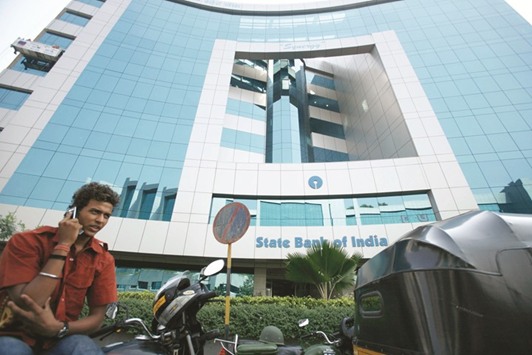
A man speaks on a mobile phone outside the State Bank of India building in Mumbai. SBI’s perpetual notes are being hoarded and hunted by traders betting the nation’s biggest lender will buy them back within the next 10 weeks as it puts its capital structure in line with Basel regulations.