


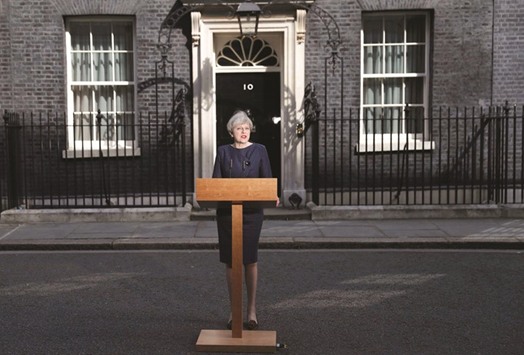
Standing outside her Downing Street office, May said she had been reluctant to ask parliament to back her move to bring forward the poll from 2020.
But, after thinking “long and hard” during a walking holiday in Wales, she decided it was necessary to try to stop the opposition “jeopardising” her work on Brexit.
Some were surprised by her move — she has repeatedly said she does not want to be distracted by campaigning — but opinion polls give her a strong lead and the economy has so far defied predictions of a slowdown.
Growth is faster-than-expected, consumer confidence is high and unemployment low, but the economy may be poised to pass its peak as consumers start to feel the strain from rising prices.
The sterling rose to a four-month high against the dollar after the market bet that May would strengthen her parliamentary majority, which Deutsche Bank said would be a “game-changer” for the pound.
But the stronger pound helped push Britain’s main share index to close down 2.3%, its biggest one-day loss since June 27, days after Britain voted to leave the EU.
“It was with reluctance that I decided the country needs this election, but it is with strong conviction that I say it is necessary to secure the strong and stable leadership the country needs to see us through Brexit and beyond,” May said.
“Before Easter I spent a few days walking in Wales with my husband, thought about this long and hard, and came to the decision that to provide that stability and certainty for the future that this was the way to do it, to have an election,” she told ITV news.
Britain joins a list of western European countries scheduled to hold elections this year.
Votes in France in April and May, and in Germany in September, have the potential to reshape the political landscape around the two years of Brexit talks with the EU expected to start in earnest in June.
May is capitalising on her runaway lead in the opinion polls.
The Conservative Party is around 20 points ahead of the main opposition Labour Party and could win around 100 additional seats in parliament.
The prime minister’s own personal ratings also dwarf those of Labour leader Jeremy Corbyn, with 50% of those asked saying she would make the best prime minister.